
Planted Aquarium CO₂
Use this guide to decide whether added carbon dioxide belongs in your planted aquarium, then plan the cylinder, regulator, diffusion, timing and monitoring as one controlled system.
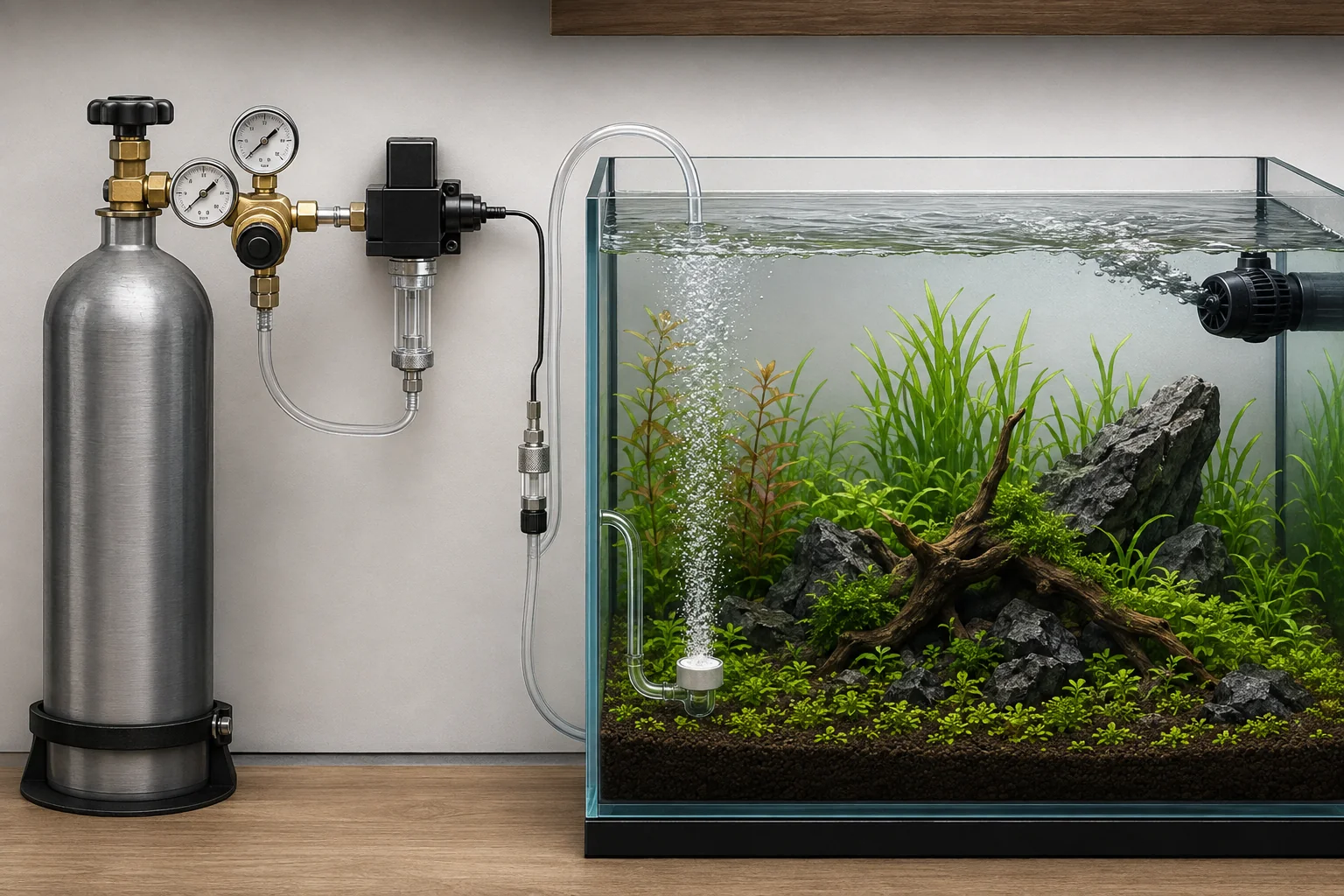
Decide whether injection fits the aquarium
Start with the plants and the result you want. Slow-growing epiphytes, mosses and many undemanding plants can suit a non-injected aquarium when light and expectations are kept realistic. Dense carpeting, frequent trimming or more demanding plants may benefit from a stable pressurised system, provided the keeper can install, monitor and maintain it safely.
CO₂ cannot compensate for poor circulation, unstable lighting, neglected maintenance or an unsuitable nutrient plan. More light usually increases plant demand and can make inconsistency more visible, so avoid upgrading lighting and gas at the same time unless the complete system has been planned.
| Question | Lower-demand route | Pressurised CO₂ route |
|---|---|---|
| Plant goal | Choose species that tolerate modest carbon availability and slower growth. | Define demanding species or growth goals that justify the extra system. |
| Maintenance | Prioritise stable light, planting density and routine care. | Add cylinder checks, leak checks, diffusion cleaning and controlled adjustment. |
| Main risk | Excess light relative to plant demand can encourage instability. | Poor assembly or excessive gas can endanger livestock and waste CO₂. |
| Evaluation | Judge healthy new growth over time. | Judge new growth together with livestock behaviour and system stability. |
Plan compatible components before buying
Confirm the cylinder standard used in your market and select a regulator explicitly rated for that cylinder, gas and working pressure. A fine-control valve helps make small adjustments; a compatible shut-off solenoid can automate timing when the manufacturer supports that configuration. Use pressure-rated tubing, a suitable check valve and a diffuser or reactor sized for the aquarium and filter flow.
Compatibility must be verified from current manufacturer documentation. Do not force adapters, lubricate fittings unless the manufacturer specifically instructs it, or mix parts whose threads, seals or pressure ratings are uncertain. Keep the cylinder secured upright, away from heat and physical damage.
Set up and adjust in a safe order
- Read the cylinder, regulator, valve and diffuser instructions before assembly.
- Secure the cylinder and assemble the dry pressure side with the specified seals and tools.
- Perform the manufacturer-approved leak check before normal operation. Never use a flame to look for leaks.
- Place the diffuser where circulation can distribute dissolved gas without eliminating surface movement needed for oxygen exchange.
- Begin conservatively and change only one control at a time. Bubble rate is device-specific and is not a transferable dose.
- Observe livestock closely, especially after changes and around the period of greatest daily CO₂ accumulation. If fish or invertebrates show unusual breathing, surface-gasping or loss of coordination, stop gas addition, increase aeration and follow qualified species-specific guidance.
Monitor the result, not a single indicator
A drop checker is a delayed visual indicator, not an instant safety alarm. Use the correct reference solution and position it away from the diffuser. Compare its trend with plant growth, circulation, surface movement and livestock behaviour. Do not chase a particular colour by making rapid adjustments.
Record the starting light schedule, gas timing, equipment position and visible plant condition. Review healthy new leaves and shoots over several maintenance cycles; old damaged leaves may not recover. If results are unstable, restore a known safe setting and diagnose flow, diffusion, timing and maintenance separately.
Continue with the focused CO₂ guides
Do you need CO₂? Decision tree
Match plant demand, light, growth goals and maintenance capacity to an injected or non-injected route.
Choose and set up a CO₂ regulator
Check cylinder compatibility, pressure control, assembly and leak-testing steps.
Choose and position a CO₂ diffuser
Compare diffusion methods and use circulation to improve distribution.
Use a CO₂ drop checker correctly
Understand placement, response delay and the limits of colour-based interpretation.
Troubleshoot unstable CO₂
Separate leaks, poor diffusion, inconsistent timing and circulation problems.
Frequently asked questions
Does every planted aquarium need added CO₂?
No. Plant choice, light level, growth goal and maintenance style determine whether the added complexity is worthwhile.
Can bubble count be copied from another aquarium?
No. Bubble size, equipment, water volume, circulation and gas loss differ. Use manufacturer guidance, conservative adjustment and direct observation of the complete system.
Is a drop checker enough to protect livestock?
No. It responds slowly and must be interpreted alongside circulation, surface movement, equipment condition and livestock behaviour.
Editorial sources
This guide uses current manufacturer guidance as a planning base. Product instructions and local cylinder standards take priority because equipment specifications can change.