
Aquarium Algae & Maintenance
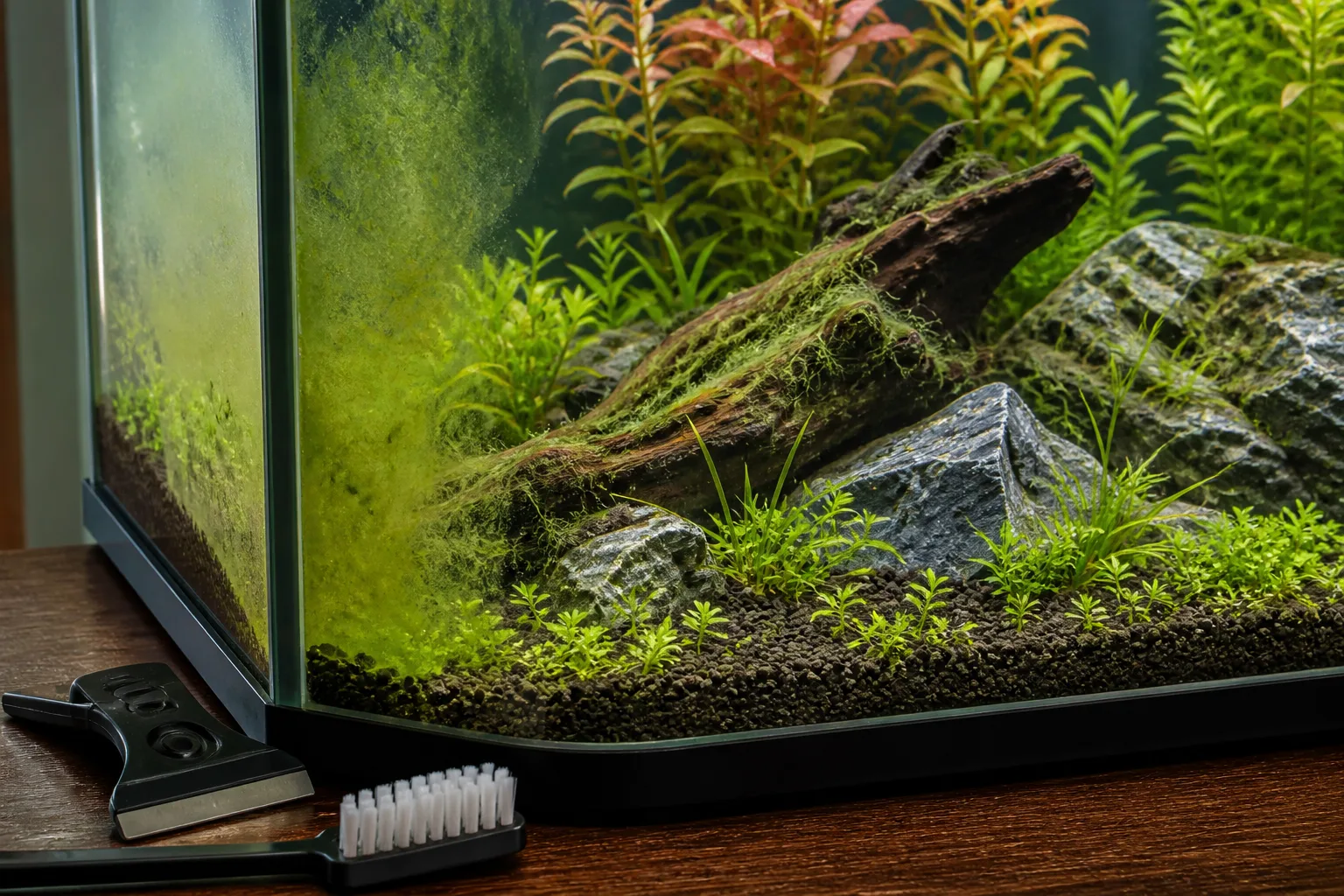
Start with identification, not treatment. Photograph the growth, record where it appears, note recent changes and check water-quality evidence before choosing a specialist guide.
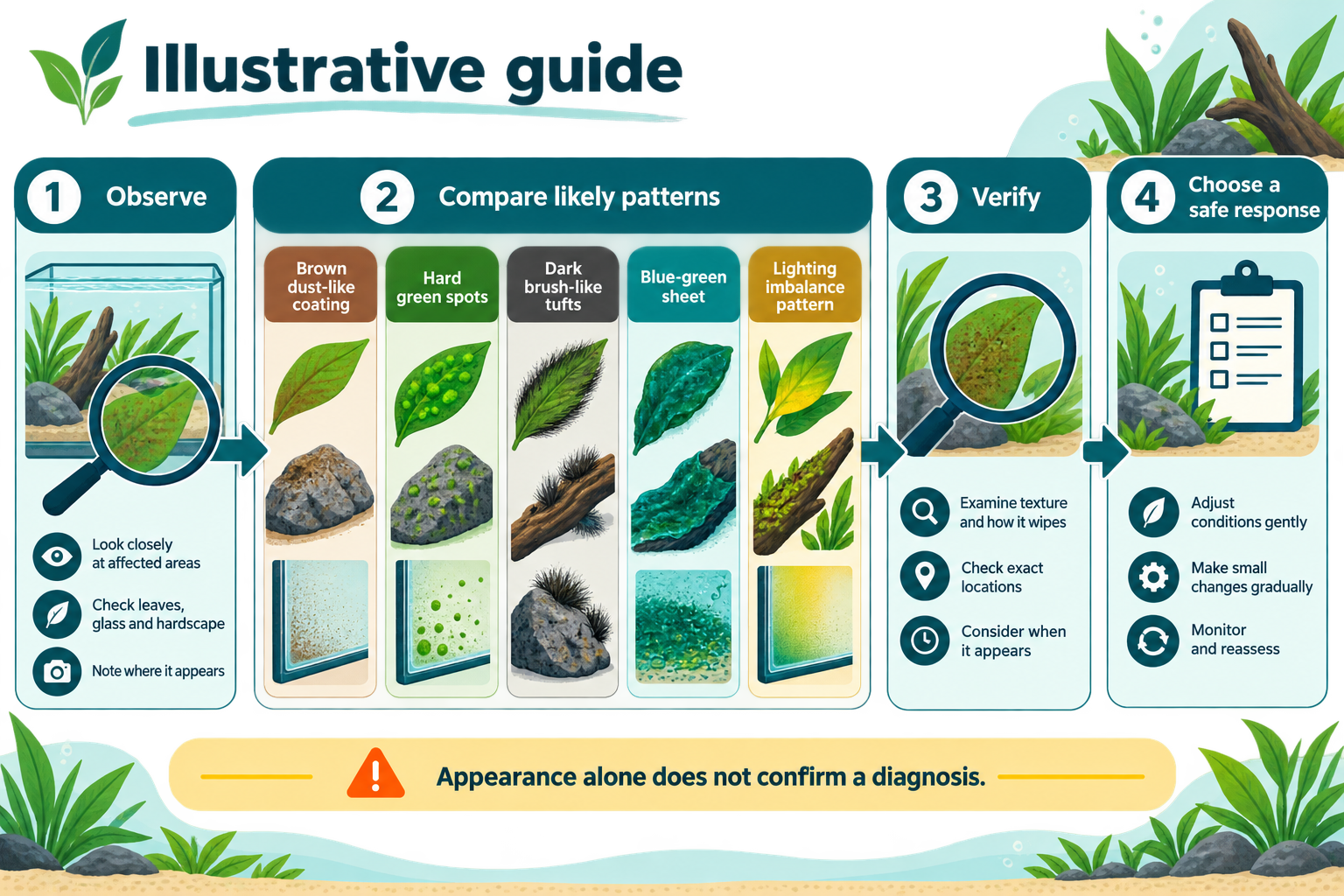
Use the illustration to choose a comparison route: check a soft brown diatom-like coating, hard green spots, dark brush-like tufts, or a blue-green sheet-like mat. If fixture timing or intensity is the strongest clue, follow the lighting-and-algae verification path.
For broader routines beyond algae diagnosis, use the everyday aquarium care guides to continue with maintenance and water-quality topics.
A four-part observation record
- Appearance: colour, texture and whether it forms spots, threads, dust or sheets.
- Location: glass, leaves, wood, substrate, equipment or open water.
- Timing: first appearance and recent changes.
- System evidence: light schedule, maintenance record and water-test method.
Tropica’s identification guide separates plankton algae, filamentous algae and algal layers into different visible groups. Source: Tropica: Types of algae.
OATA explains that ammonia and nitrite are toxic to fish and that water-quality testing can reveal changes in an aquarium. Source: Ornamental Aquatic Trade Association: How to test water quality in your freshwater tank / aquarium.
Use appearance only to choose a comparison route
The descriptions below are search routes, not identifications. More than one organism or condition can look similar in a photograph, so keep the label unconfirmed until the focused guide’s evidence and exclusions have been checked.
| Initial note—not a diagnosis | Guide to open for comparison | Required uncertainty |
|---|---|---|
| You recorded dark tufts on an edge or hardscape | Compare the black beard algae guide | The phrase “dark tufts” does not establish identity. |
| You recorded hard-looking green spots | Compare the green spot algae guide | Colour and shape alone do not establish identity or cause. |
| You recorded a brown coating in a newer setup | Compare the diatoms guide | Age and colour are routing notes, not a diagnosis. |
| You recorded a slimy-looking sheet or mat | Compare the cyanobacteria guide | Do not classify the material from this description alone. |
Maintenance without erasing evidence
Do not combine a blackout, chemical, large cleaning event and feeding change and then claim one of them solved the problem. Preserve the before state, follow exact product instructions where a product is used, and record one controlled change.
Build a case note before choosing an action
| Evidence field | Useful entry | Entry to avoid |
|---|---|---|
| Appearance | “Short dark tufts on the edge of older leaves” | “Bad algae” |
| Location | “Mostly near the outlet and on one branch” | “Everywhere” without a map |
| Timeline | First photograph plus dated change log | A memory-only estimate |
| Recent change | Exact lighting, feeding or maintenance change | Several changes grouped together |
| Water evidence | Test method, date and result | “Water looks clean” |
Use pattern and timing to narrow the question
If the growth is limited to one material or flow zone, preserve that location in the record. If it appeared after a documented change, keep the before and after settings. If the identity is uncertain, compare it with the focused guides without importing their treatment sections. The purpose of this hub is to choose the next diagnostic question, not to make all visible growth share one cause.
Example comparison paths
- If your note says “hard-looking green spots”: open the green spot guide to compare its evidence requirements; do not name the growth from the note alone.
- If your note says “brown coating in a newer setup”: open the diatoms guide and carry over setup age and water evidence while keeping identity unconfirmed.
- If your note says “dark edge tufts”: open the black beard algae guide as a comparison route and check its distinguishing evidence before using that label.
- If your note says “slimy-looking sheet”: open the cyanobacteria guide for comparison and leave the classification open until its evidence boundary is met.
For observations from a newly planted setup, use the first-30-days planted aquarium record before attributing a change to algae or maintenance alone.
When this hub must stop
This page does not diagnose disease, prescribe antibiotics, provide an algaecide dose or set livestock-safe chemistry. Escalate abnormal animal behaviour or unresolved water-quality risk to a qualified aquatic professional.