
Aquarium Plant Fertilization
Build an aquarium fertilisation plan around the plants, substrate, light, carbon supply and real water volume, then adjust it from documented new growth instead of isolated symptoms.
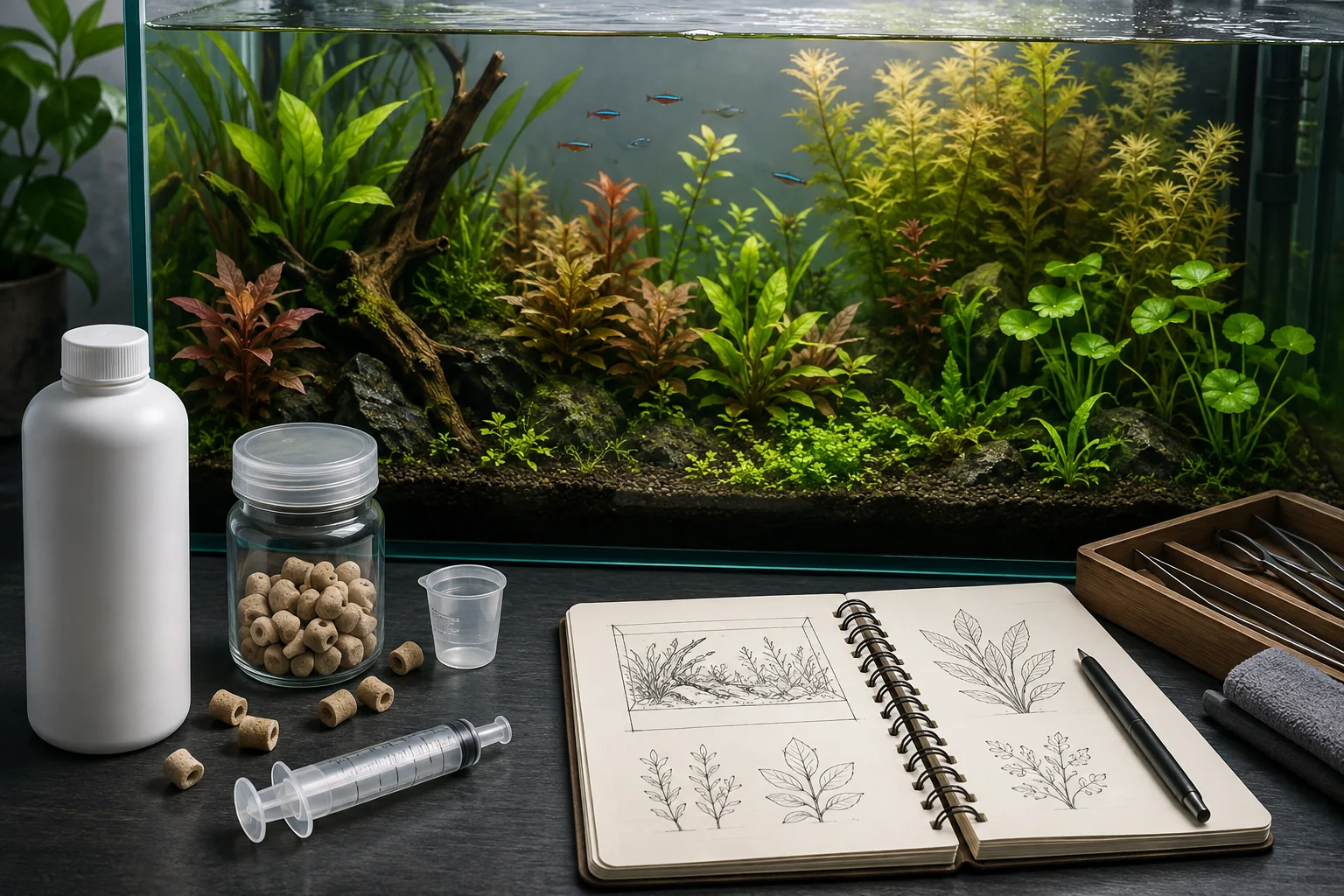
Understand what the routine is trying to supply
Aquatic plants use macronutrients such as nitrogen, phosphorus and potassium in relatively larger amounts, plus micronutrients in smaller amounts. The presence of a nutrient on a label does not prove the aquarium needs an extra product: tap water, fish food, livestock waste, substrate and existing fertilisers may already contribute.
Demand also changes with plant mass, species, growth rate, light and carbon availability. A heavily planted, fast-growing aquarium may use nutrients differently from a lightly planted tank under modest light. Fertiliser should therefore support a stable system rather than chase maximum dosing.
| Planting situation | Useful starting route | What to verify |
|---|---|---|
| Epiphytes and many stem plants | A documented water-column programme may be the main route. | Product composition, actual dose, light and carbon consistency. |
| Heavy root feeders in inert substrate | Targeted root nutrition may complement the water column. | Placement, replacement interval and livestock-safe use from the manufacturer. |
| New active substrate | Follow the substrate maker’s start-up and fertilisation instructions. | What the substrate releases, required water changes and when supplementation begins. |
| Mixed planting | A complete programme may combine routes without duplicating nutrients. | Total inputs across every liquid, capsule, tab and substrate product. |
Build a dosing routine you can audit
- List every nutrient source, including the substrate, root products and liquids.
- Estimate real operating water volume rather than relying only on the tank’s external dimensions. Follow the product label if it defines dose by total volume, replaced water or another basis.
- Select one main programme and begin within its stated instructions. Do not convert caps or pumps between brands without checking the measured volume they dispense.
- Use a repeatable schedule and record the product, amount, date, water change and any skipped dose.
- Keep light, CO₂ and maintenance stable while evaluating the routine.
- Review healthy new growth and compare photographs taken from the same angle and lighting.
If a product’s composition or aquarium suitability is unclear, do not guess a dose. Obtain current manufacturer guidance or choose a better-documented alternative.
Diagnose patterns before adding more
Yellowing, holes, twisted shoots, slow growth and algae can have several causes. A visual symptom alone cannot confirm a nutrient deficiency because old-leaf damage, transplant stress, shading, poor circulation, unstable carbon, unsuitable light and root problems can look similar.
| Observation | Check before changing fertiliser |
|---|---|
| Pale or distorted new growth | Confirm the affected growth is truly new, then review the complete programme, carbon stability and species requirements. |
| Damage mainly on old leaves | Separate ongoing new damage from leaves that were already compromised or adapting. |
| Slow growth across the tank | Review light coverage, carbon availability, temperature, planting density and recent maintenance. |
| Algae after a dosing change | Check whether light, CO₂, flow or several inputs changed at the same time; do not assume one nutrient is the sole cause. |
Adjust cautiously and protect the system
Make one small, documented change within the product instructions, then allow enough time for new growth to show the direction of travel. Do not use livestock distress, an algae outbreak or one test result as a target for aggressive correction. Follow label precautions, keep concentrates away from children and animals, and avoid mixing products unless their manufacturers explicitly support the combination.
Water changes should follow the fertiliser programme, substrate instructions and livestock needs. They can help reset accumulated inputs, but they do not replace correct dosing or routine aquarium care.
Continue with the focused fertilisation guides
Macro and micro nutrients
Understand nutrient roles without diagnosing the aquarium from one symptom.
Build a fertiliser dosing routine
Translate the product instructions and real water volume into a repeatable schedule.
Diagnose aquarium plant deficiencies
Compare new and old growth, rule out confounding causes and document changes.
Liquid fertiliser or root tabs?
Match the delivery route to plant type, substrate and the rest of the nutrient programme.
Fertiliser selector
- If plants mainly feed from the water column, compare a complete, documented liquid programme.
- If rooted plants grow in inert substrate, check whether targeted root nutrition is appropriate.
- If an active substrate is new, follow its specific start-up and fertilisation guidance.
- If symptoms are unclear, stabilise light and carbon, then review new growth before changing the programme.
- If two products overlap, calculate the combined input rather than treating them as separate solutions.
Frequently asked questions
Should fertiliser be dosed from the tank’s advertised volume?
Use the volume basis stated by the product. Hardscape, substrate and the normal water line can make operating water volume lower than the aquarium’s nominal capacity.
Do yellow leaves prove one nutrient is missing?
No. The age and position of affected leaves help, but light, carbon, roots, recent changes and species behaviour must also be reviewed.
Can liquid fertiliser and root tabs be used together?
Sometimes, when the plants and substrate justify both routes. Check the complete nutrient input and follow each manufacturer’s compatibility and dosing guidance.
Editorial sources
This guide uses current manufacturer guidance as a planning base. Exact products, concentrations and substrate instructions can change, so the current label takes priority.