
How to Choose the Best Automatic Fish Feeder for Your Aquarium
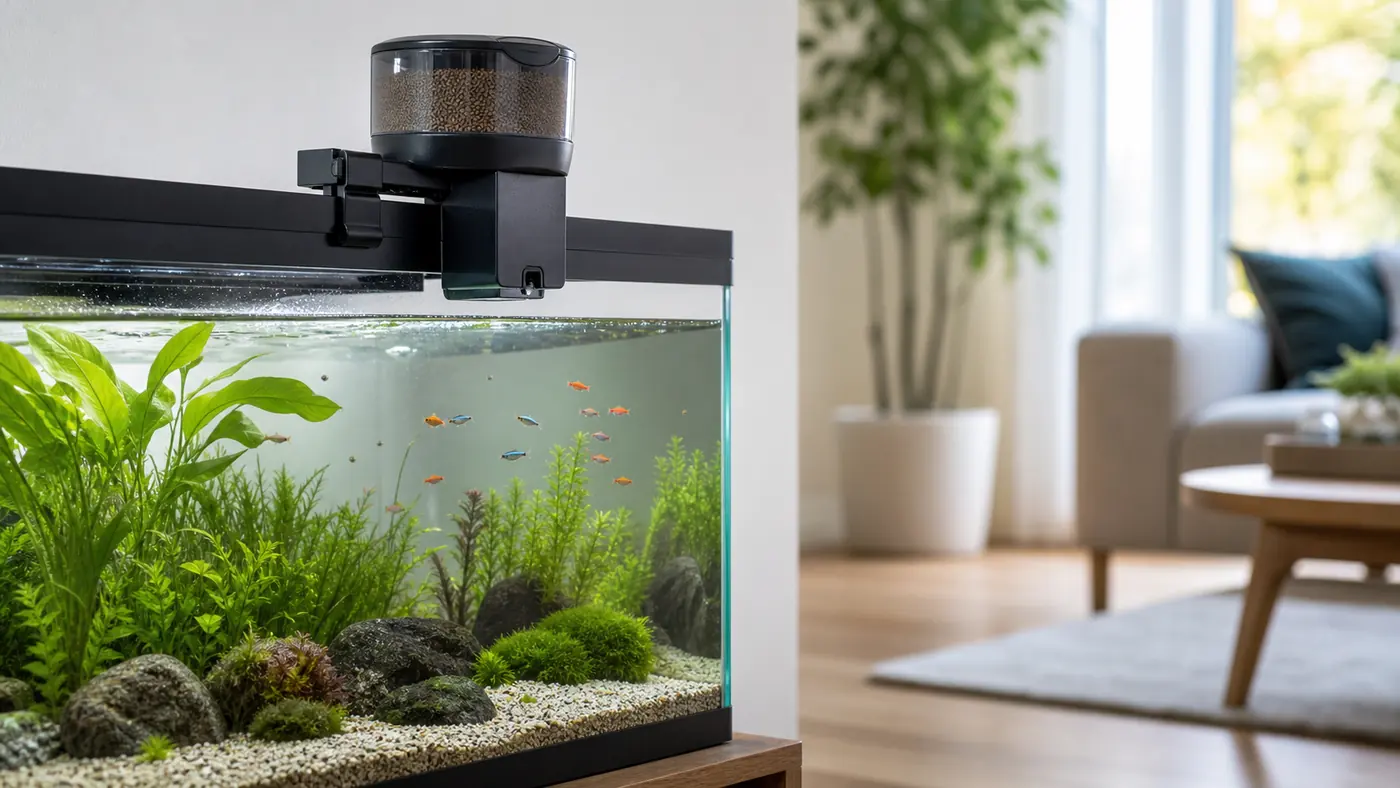
An automatic fish feeder looks like a simple convenience until you ask it to do a surprisingly difficult job: dispense a small, repeatable amount of food in a damp environment, at the right time, without anyone standing beside the tank. (EHEIM autofeeder 3581 Operating Manual)
That is why the best feeder is not necessarily the model with the largest drum, the most buttons or the longest list of features. It is the feeder that works with your aquarium, your fish and the food you already use—and continues to do so after several real-world tests.
This guide explains what matters, what is mostly marketing, and how to make a confident choice without overbuying.
Start with the food, not the feeder
Before comparing timers or capacities, look at the food your fish actually eat. Dry pellets and uniform granules usually move through a feeder more predictably than large flakes, irregular sticks or mixed food sizes. Flakes can settle, bridge across an outlet or break into smaller pieces as the drum turns. Very fine granules may release more quickly than expected. (EHEIM autofeeder 3581 Operating Manual)
If changing food would be inappropriate for your fish, choose a feeder that can handle the existing diet. Our guide to fish food types and automatic feeder compatibility explains the differences in more detail.
Useful questions to ask are:
- Does the manufacturer name the compatible food formats?
- Can the outlet be adjusted in small increments?
- Can you see the food level without opening the drum?
- Is the food chamber protected from condensation and spray?
- Can the feeder release a genuinely small portion?
Food compatibility is not a footnote. It determines whether the portion you set is the portion your fish receive. (EHEIM autofeeder 3581 Operating Manual)
Compare portion control before capacity
A large container sounds reassuring, especially before a holiday, but capacity is only useful when the feeder can dispense accurately. A drum that holds weeks of food but releases inconsistent amounts creates more risk, not less. (EHEIM Automatic Feeder Catalogue)
Look for an adjustment mechanism that is easy to change but difficult to move accidentally. The smallest useful setting matters more than the largest. This is especially important in nano aquariums, lightly stocked tanks and aquariums with small fish.
Manufacturers often describe capacity in millilitres or number of feeds. Treat those figures as estimates. The real duration depends on food density, portion size, feeding frequency and how full the chamber can be without affecting movement. (EHEIM Automatic Feeder Catalogue)
Once you choose a model, use the process in our automatic fish feeder setup and calibration guide before allowing food to fall into the aquarium.
Choose a timer that matches the routine
Some feeders operate on a simple 12- or 24-hour cycle. Others allow several feeding times per day, double portions or different schedules on different days. More flexibility is helpful only if the controls remain clear. (EHEIM autofeeder 3581 Operating Manual)
For many home aquariums, a dependable daily schedule is more valuable than a complicated programme. Check whether: (FAO: Freshwater Fish Feeding Management)
- the first feeding starts immediately when the unit is switched on;
- scheduled times remain saved when batteries are changed;
- a manual-feed button is available for testing;
- the display clearly shows active feeding times;
- buttons can be pressed without moving the feeder;
- the clock or interval can be checked at a glance.
Do not select a schedule simply because the feeder offers it. Feeding frequency should be based on the species, age, health and normal routine of the fish. See our aquarium fish feeding schedule guide for a safer way to plan frequency and portions.
Check how the feeder mounts to your tank
Automatic feeders are commonly fixed to an open rim, placed over a feeding opening or attached to a lid. A secure installation prevents the unit from shifting, dropping food onto a solid cover or—worst of all—falling into the aquarium. (EHEIM autofeeder 3581 Operating Manual)
Measure the available space before buying. Look at the hood, light, filter return and condensation tray. The food should land where fish can reach it, away from an overflow or strong surface flow that carries it directly into the filter. (EHEIM autofeeder 3581 Operating Manual)
If the aquarium has a full lid, confirm that the feeder can work through an existing hatch. Cutting or modifying a cover is not a sensible first plan unless the aquarium manufacturer says it is safe. (EHEIM autofeeder 3581 Operating Manual)
Moisture protection is a reliability feature
Aquariums are humid. Food that absorbs moisture can swell, stick together, spoil or block an outlet. A sealed drum helps, but placement and ventilation still matter. (EHEIM autofeeder 3581 Operating Manual)
Some feeders use an air inlet, fan or optional air-pump connection to keep food moving. Others depend on the chamber remaining away from spray. No design removes the need for regular inspection. (EHEIM autofeeder 3581 Operating Manual)
When comparing products, look for:
- a covered outlet between feeding cycles;
- an aerated or ventilated food chamber;
- a splash-resistant control panel;
- parts that can be removed and cleaned;
- an outlet that does not sit directly above rising bubbles;
- clear maintenance instructions.
Our troubleshooting article on preventing clumps and missed feeds covers practical moisture control.
Battery, USB or mains power?
Battery-operated feeders continue working during a household power cut, provided the batteries are healthy. USB or mains-powered models avoid routine battery replacement but may stop during a power failure unless they have backup power. (U.S. CPSC Home Electrical Safety Checklist)
Neither option is automatically better. What matters is knowing how the feeder behaves when power is interrupted.
For battery models, a visible low-battery warning is valuable. Fit fresh, good-quality batteries before an important trip and check the contacts for corrosion. For powered models, confirm whether the schedule is retained after disconnection and whether the cable can be routed safely with a drip loop. (EHEIM autofeeder 3581 Operating Manual) (U.S. CPSC Home Electrical Safety Checklist)
Smart feeders may add alerts or remote control, but connectivity introduces another layer to test. Read our guide to smart and Wi-Fi automatic fish feeders before paying extra for app features.
A simple comparison checklist
Use this short checklist when comparing two or three models:
| Criterion | What good looks like |
|---|---|
| Food compatibility | Explicit support for your usual dry food |
| Minimum portion | Small and repeatable during tray tests |
| Schedule | Matches the fish’s established routine |
| Mounting | Secure fit with a clear drop path |
| Moisture control | Covered outlet, ventilation or clear placement guidance |
| Power | Visible status and predictable behaviour after interruption |
| Cleaning | Food-contact parts are accessible |
| Instructions | Programming and maintenance steps are unambiguous |
Red flags that deserve a second look
Be cautious when a listing promises a fixed number of months without explaining the portion or schedule used to calculate it. The same applies to claims that a feeder is completely moisture-proof, suitable for every food or safe to leave unchecked. (EHEIM Automatic Feeder Catalogue)
Also look carefully at product photographs. A large drum paired with a wide, coarse outlet may not suit a small tank. A clamp designed for open glass may be useless on a moulded hood. A polished app cannot compensate for an unreliable mechanical dispenser.
Is DaraSphere’s 24-hour feeder suitable for you?
Before considering a simple 24-hour feeder, verify current documentation for the timing mode, compatible food, dimensions, mounting and power. Product suitability depends on the aquarium and on a repeatable tray test.
Before ordering, compare the product dimensions with the space above your tank, confirm that a 24-hour cycle matches your fish’s routine, and plan to test the exact food and portion. Product suitability depends on the aquarium—not just the feeder specification.
Frequently asked questions
Can an automatic feeder be used every day?
Yes, provided it is suitable for the food and tank, calibrated correctly and checked regularly. Daily automation should not replace observing the fish or maintaining the aquarium. (RSPCA: What to Feed Your Fish)
Are pellets better than flakes in an automatic feeder?
Uniform pellets or granules often dispense more consistently, but the correct food is the one that meets the fish’s dietary needs. Never change diet purely to suit a device without considering the species. (EHEIM autofeeder 3581 Operating Manual) (Merck Veterinary Manual: Nutrition in Fish)
How far in advance should I test a new feeder?
Allow several days. Run scheduled releases over a tray, then observe the feeder on the aquarium while you are still home. A longer test is sensible before an extended trip. (RSPCA: What to Feed Your Fish)
Does the largest feeder last the longest?
Not necessarily. Duration depends on capacity, portion size and feeding frequency. Overfilling can also affect food movement in some designs. (EHEIM Automatic Feeder Catalogue)
Should someone still check the aquarium while I am away?
Yes. A responsible person should verify that the feeder and other equipment are operating and that the fish appear normal. Automation reduces repetitive work; it does not make an aquarium failure-proof. (RSPCA: What to Feed Your Fish)
The best feeder is the one you have tested
Specifications help you create a shortlist. A tray test and a few days of observation tell you whether the feeder actually belongs on your aquarium.
Choose for food compatibility, repeatable small portions, secure mounting, moisture control and predictable power behaviour. Then test patiently. That combination is far more useful than a long feature list—and much safer for the fish.
Editor’s source note: General holiday-feeding precautions should be checked against current animal-welfare guidance. Model-specific claims should be verified on the relevant manufacturer page before publication.
Build a reliable automatic-feeding setup
Start with a compatible feeder, then protect the routine with suitable water-care and maintenance equipment.
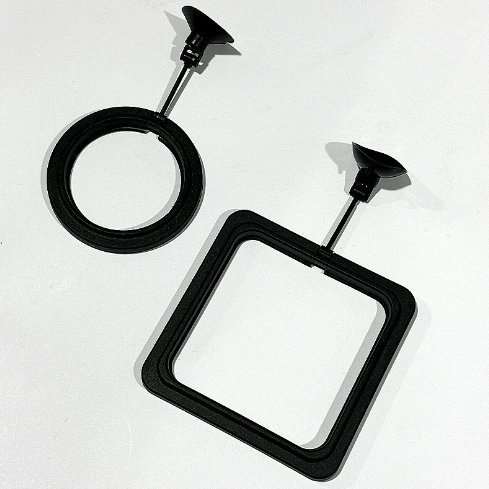
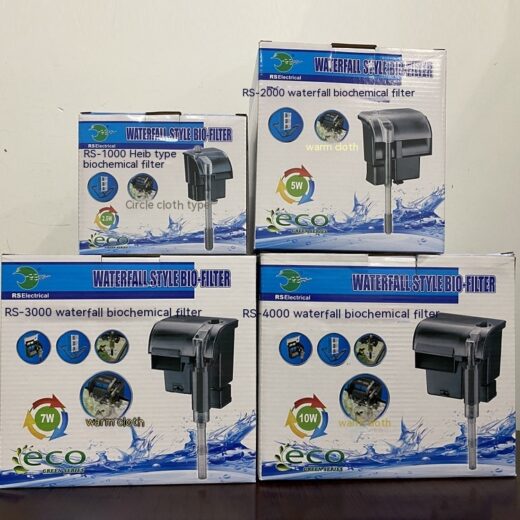
Aquarium Waterfall Bio Filter – RS1000 to RS4000
Products matched to this guide
Selected for relevance to the setup and needs covered above.
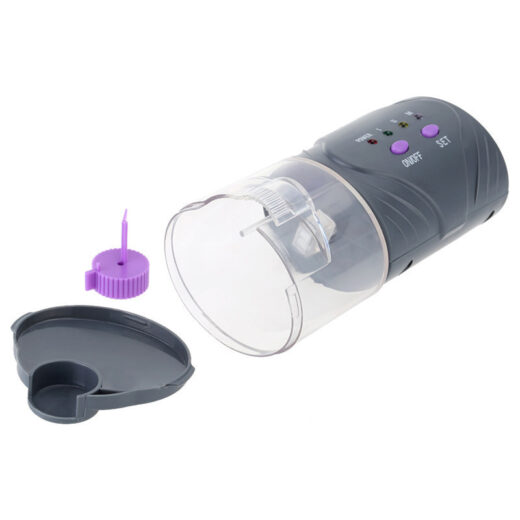
12/24-Hour Automatic Aquarium Fish Feeder
12/24-Hour Automatic Aquarium Fish Feeder — Schedule suitable dry food every 12 or 24 hours and…
View product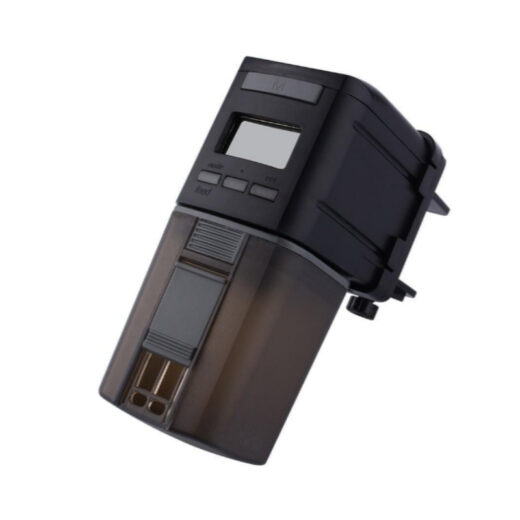
Automatic Fish Feeder for Goldfish & Koi – Standard/Wi-Fi
Automatic dry-food feeder for goldfish and koi, available as a standard black model or Wi-Fi remote-control…
View product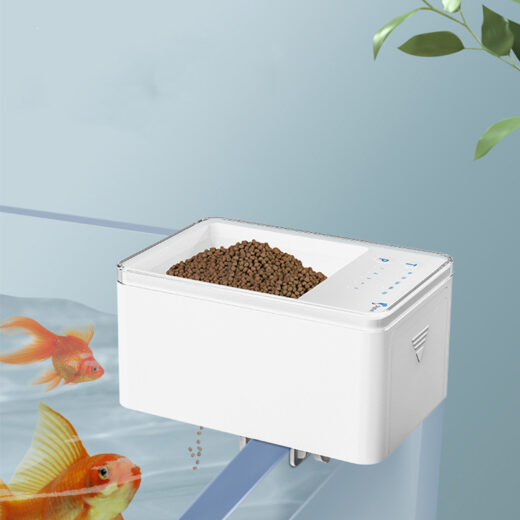
Digital Automatic Fish Feeder with LED Display – 500 ml
A compact 500 ml automatic aquarium feeder with an LED display, 24-hour scheduling and one-to-four daily…
View product