
Which Fish Food Works Best in an Automatic Feeder?
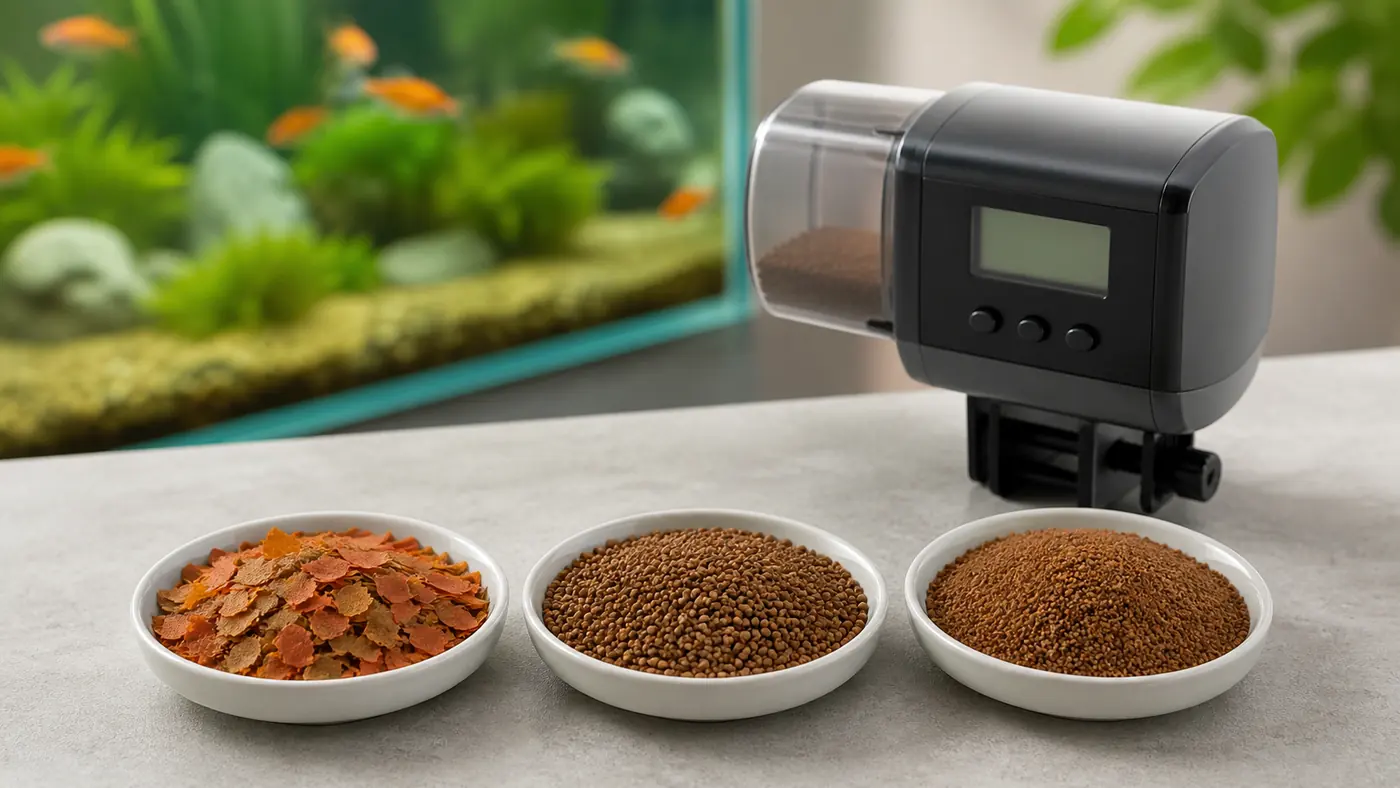
An automatic feeder can be programmed perfectly and still deliver the wrong amount. The usual reason is not the timer—it is the food. (EHEIM autofeeder 3581 Operating Manual)
Flakes, pellets and granules behave differently inside a drum. They have different shapes, weights and responses to humidity. Even two foods that look similar in the container can fall through the same outlet at very different rates. (EHEIM autofeeder 3581 Operating Manual)
The right question is therefore not “Which food is best?” It is “Which nutritionally appropriate food can this feeder dispense consistently for these fish?”
Use the species-conscious fish-care collection when matching feeding routines to the animals and habitat.
Nutrition comes before convenience
Do not change a suitable diet simply because a different food moves more easily through a device. Species, mouth size, feeding zone, age and health should determine nutrition. The feeder must fit that decision—not reverse it. (Merck Veterinary Manual: Providing a Home for Fish)
If the fish rely on frozen, live, gel or highly specialised food, a standard dry-food feeder may only cover part of the routine. A sitter or a different feeding system may be necessary. (Merck Veterinary Manual: Nutrition in Fish) (EHEIM autofeeder 3581 Operating Manual)
Flakes: familiar but irregular
Flake food is widely used because it is easy to portion manually and can be broken for different fish sizes. Inside an automatic feeder, however, flakes can create several challenges:
- large pieces may bridge across the outlet;
- small fragments settle and dispense faster;
- flakes can compress when the drum is packed;
- humidity can make them stick together;
- repeated rotation may break them into dust.
Source for the preceding checklist: EHEIM autofeeder 3581 Operating Manual
This does not mean flakes cannot work. Use a feeder that explicitly supports them, avoid crushing the food while filling, and test multiple cycles. A setting that works with a newly opened pack may change as the flakes break down over time. (EHEIM autofeeder 3581 Operating Manual)
Pellets: repeatable when the size is right
Uniform pellets often produce a more consistent release because their size and weight vary less. They are also easier to count or weigh during a calibration test. (EHEIM autofeeder 3581 Operating Manual)
Problems arise when pellets are larger than the outlet, too small for the adjustment gap or unsuitable for the fish. Floating and sinking pellets may also land differently in the aquarium. Make sure the intended fish can reach the food before it enters the filter or rests in an inaccessible area. (EHEIM autofeeder 3581 Operating Manual)
Granules: useful, but easy to over-dispense
Small granules flow freely, which can be an advantage in a compact feeder. That same quality can cause an unexpectedly large portion if the outlet is opened even slightly too far. (EHEIM autofeeder 3581 Operating Manual)
Start at the minimum setting and collect several releases over white paper. Fine granules are easier to see and compare against a plain background. If the feeder cannot produce a sufficiently small amount, it is not suitable for that food-and-tank combination. (EHEIM autofeeder 3581 Operating Manual)
Sticks and wafers: check the mechanism
Food sticks vary in length and may jam a narrow rotating outlet. Large algae wafers may not fit a conventional drum at all. Some feeders use individual compartments, which can hold pre-measured wafers or mixed meals more reliably than an adjustable opening. (EHEIM Automatic Feeder Catalogue)
Never force large food into a mechanism. Broken pieces may change the nutritional portion and dispensing behaviour. (EHEIM autofeeder 3581 Operating Manual)
Why mixed food can separate
Mixing flakes, pellets and granules sounds like a convenient way to provide variety. During rotation, however, smaller and denser pieces may settle toward the bottom while larger flakes remain above. Early portions and late portions can therefore have different compositions. (EHEIM Automatic Feeder Catalogue)
If you want to use a mixture:
- combine only foods that are all appropriate for the fish;
- keep particle sizes reasonably similar;
- test the mixture through many cycles;
- inspect the remaining food for separation;
- avoid preparing more mixture than you can keep fresh.
A feeder with separate chambers may be a better option when different foods must remain distinct. (EHEIM Automatic Feeder Catalogue)
Moisture changes everything
Dry food is designed to remain dry until it reaches the aquarium. Steam-like humidity rises from the water surface, and spray can reach a feeder positioned near a filter return or air stone. Once food absorbs moisture, its flow rate changes. (EHEIM autofeeder 3581 Operating Manual)
Keep the outlet away from splashing, use ventilation when the feeder supports it, and avoid filling a damp drum. Clean removable parts and allow them to dry completely. Our guide to preventing clogs and damp food provides a full maintenance routine.
Run a food-flow test
Use the exact food—not a substitute—during setup.
- Place the feeder over a tray.
- Fill it to the level you expect to use.
- Select the smallest opening.
- trigger or wait for at least five releases;
- compare the portions visually or with a small scale;
- repeat after the feeder has sat filled for a day;
- check again near the end of the chamber.
Source for the preceding checklist: EHEIM autofeeder 3581 Operating Manual
The first and last portions may differ if food settles or the drum angle changes. Record the results instead of relying on one successful release. (EHEIM autofeeder 3581 Operating Manual)
For a complete setup process, read how to calibrate an automatic fish feeder.
Match the food to the fish’s feeding zone
Food must not only leave the feeder—it must reach the intended fish.
- Floating food suits many surface and mid-water feeders but may be pulled toward an overflow.
- Slow-sinking food gives fish time to feed through different levels.
- Fast-sinking pellets can help bottom feeders but may disappear into coarse substrate.
- Tablets and wafers may need targeted placement rather than a rotating dispenser.
Source for the preceding checklist: Merck Veterinary Manual: Providing a Home for Fish
In a community aquarium, watch an actual feeding cycle. Confirm that bold fish are not taking everything before shy or bottom-dwelling species have access. Our species-specific automatic feeder guide explains these differences.
A quick compatibility table
| Food format | Typical feeder behaviour | Main test |
|---|---|---|
| Large flakes | Irregular; may bridge or break | Compare multiple portions and inspect for fragments |
| Small flakes | Better flow but may dispense quickly | Start with the smallest outlet |
| Uniform pellets | Often repeatable | Confirm pellet diameter and sinking behaviour |
| Fine granules | Free-flowing; over-dispensing risk | Measure several minimum-setting releases |
| Sticks | Possible jamming | Confirm manufacturer compatibility |
| Wafers/tablets | Often too large for a drum | Consider compartment or manual feeding |
| Mixed foods | May separate by size and density | Test early, middle and late portions |
Can DaraSphere’s feeder use your food?
Before using any scheduled dry-food feeder, compare its documented food formats, outlet and chamber with the food you use. A timer can maintain a routine only when the food releases predictably.
Frequently asked questions
Are pellets always better than flakes?
No. Pellets may dispense more consistently, but the diet must suit the fish. Flakes can work in a compatible feeder after careful testing. (EHEIM autofeeder 3581 Operating Manual) (Merck Veterinary Manual: Nutrition in Fish)
Can I crush flakes before filling the feeder?
Crushing changes particle size and can create dust that dispenses unevenly. If smaller food is needed, choose an appropriate product and recalibrate. (EHEIM autofeeder 3581 Operating Manual)
Why did the feeder release more food after a few days?
Food may have settled, broken into smaller particles or dried further. The outlet may also have moved. Inspect the chamber and repeat the tray test. (EHEIM autofeeder 3581 Operating Manual)
Can frozen food go in an automatic feeder?
Standard dry-food feeders are not designed to keep frozen food safe. Use equipment made for that purpose or arrange suitable human feeding. (EHEIM autofeeder 3581 Operating Manual)
The best food is nutritious and predictable
Automatic feeding works when nutrition and mechanics agree. Choose appropriate food for the fish, then prove that the device can release it in small, repeatable portions.
That short test protects both sides of the aquarium equation: the fish receive the intended diet, and the water is not burdened with food they never had a chance to eat.
Build a reliable automatic-feeding setup
Start with a compatible feeder, then protect the routine with suitable water-care and maintenance equipment.
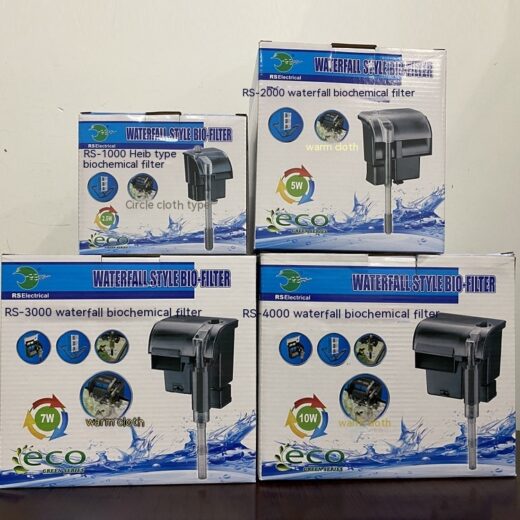
Aquarium Waterfall Bio Filter – RS1000 to RS4000
Products matched to this guide
Selected for relevance to the setup and needs covered above.
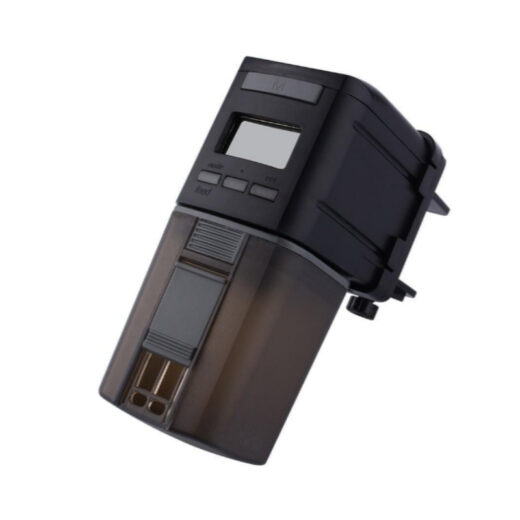
Automatic Fish Feeder for Goldfish & Koi – Standard/Wi-Fi
Automatic dry-food feeder for goldfish and koi, available as a standard black model or Wi-Fi remote-control…
View product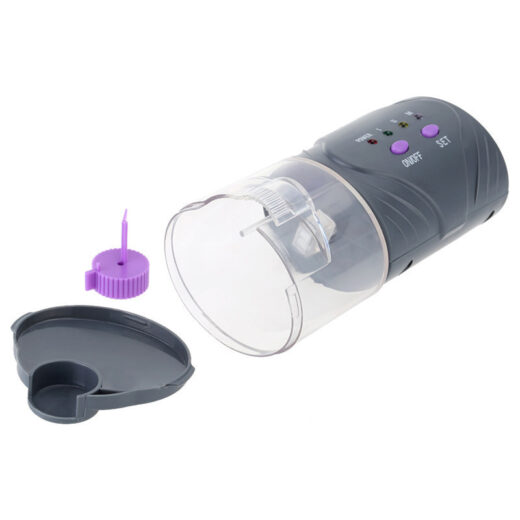
12/24-Hour Automatic Aquarium Fish Feeder
12/24-Hour Automatic Aquarium Fish Feeder — Schedule suitable dry food every 12 or 24 hours and…
View product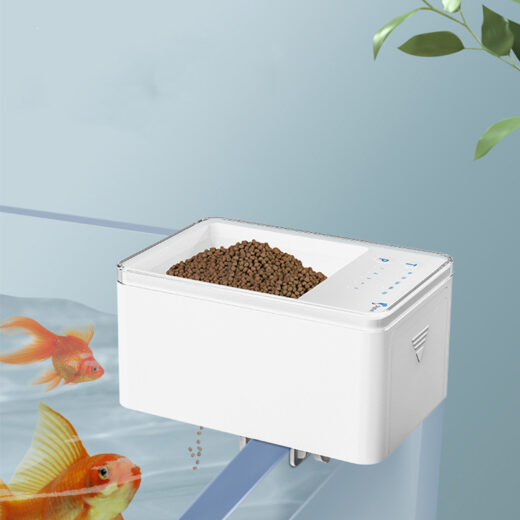
Digital Automatic Fish Feeder with LED Display – 500 ml
A compact 500 ml automatic aquarium feeder with an LED display, 24-hour scheduling and one-to-four daily…
View product