
How to Prevent Automatic Fish Feeder Clogs and Damp Food
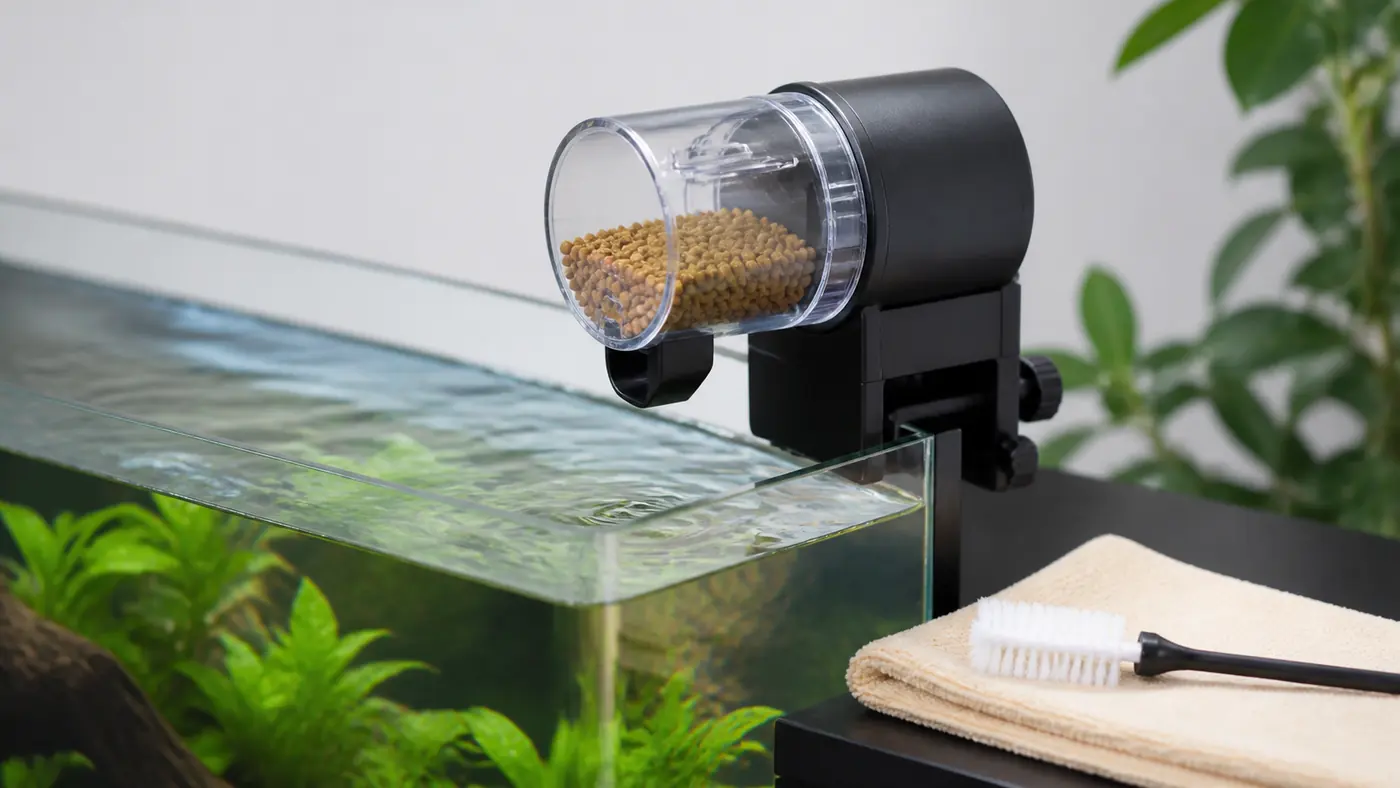
Automatic feeders work with dry food in one of the dampest places in the home. That tension explains most dispensing problems. (EHEIM autofeeder 3581 Operating Manual)
When food absorbs moisture, flakes can fold together, pellets may swell and fine granules can form a compact layer around the outlet. The feeder may release too little, nothing at all or a larger lump later. (EHEIM autofeeder 3581 Operating Manual)
Clog prevention starts with placement and food handling—not with opening the outlet wider.
Keep the feeder away from spray
Look at the water surface while the filter and air pump are running. Tiny droplets may reach farther than expected. Avoid mounting the feeder directly above:
- an air stone or bubble curtain;
- a splashing filter return;
- an overflow;
- a strong surface agitator;
- an area where condensation collects on the lid.
Source for the preceding checklist: EHEIM autofeeder 3581 Operating Manual
The food still needs a clear path into the aquarium. Choose a position that is both dry and accessible to the fish.
Start with a completely dry chamber
After cleaning, allow every food-contact part to air-dry fully. A small amount of hidden water can affect a full drum of food. (EHEIM autofeeder 3581 Operating Manual)
Do not top up new food over old damp residue. Empty the chamber, inspect the outlet and clean according to the manufacturer’s instructions. Avoid detergents or chemicals unless specifically approved for the food-contact parts. (EHEIM autofeeder 3581 Operating Manual)
Use compatible dry food
Large flakes can bridge across an opening, while very fine granules may compact. Uniform pellets often move predictably, but they must be small enough for the outlet and appropriate for the fish. (EHEIM autofeeder 3581 Operating Manual)
Read which foods work best in automatic feeders and test the exact food over a tray.
Do not overfill the drum
A completely packed container may prevent food from tumbling or mixing as intended. Follow the stated fill level. If no level is given, leave enough space for the mechanism to move food freely. (EHEIM autofeeder 3581 Operating Manual)
For long trips, do not assume that more food creates more security. A larger damp mass can create a larger failure. Capacity should be calculated from the tested portion and schedule. (RSPCA: What to Feed Your Fish) (EHEIM autofeeder 3581 Operating Manual)
Use ventilation correctly
Some feeders have an integrated fan, air inlet or connection for an external air pump. Use only the method described by the manufacturer. Extra airflow is not automatically beneficial if it introduces humid air, dust or an unsafe cable arrangement. (EHEIM Automatic Feeder Catalogue)
Keep ventilation openings clear. Do not cover them with tape to make the chamber look more sealed.
Clean on a predictable schedule
The correct interval depends on food dust, humidity and use. Inspect the outlet whenever you refill and after any missed or unusual portion. (EHEIM autofeeder 3581 Operating Manual)
A simple routine is:
- switch off or disconnect the feeder safely;
- remove remaining food;
- brush away dry crumbs;
- clean removable parts as instructed;
- dry completely;
- inspect the adjustment opening;
- refill with fresh dry food;
- repeat the tray calibration.
Source for the preceding checklist: EHEIM autofeeder 3581 Operating Manual
Do not submerge electronics.
Troubleshoot a missed feed
If the feeder turns but releases no food:
- check for a visible bridge or clump;
- confirm that the outlet has not moved closed;
- inspect the food for swelling or stickiness;
- reduce the fill level;
- verify particle size;
- clean and dry the mechanism;
- run several tray tests.
If the feeder does not turn, check power, batteries, schedule and manual-feed controls. Consult the instructions before forcing the mechanism.
If a large clump suddenly falls into the aquarium, remove accessible excess food and monitor water quality. Do not add another portion to compensate for uncertainty. See overfeeding and water-quality troubleshooting.
A pre-trip moisture test
Run the loaded feeder in its final aquarium position for several days. Each day, inspect: (EHEIM autofeeder 3581 Operating Manual)
- the chamber walls;
- the outlet edge;
- the texture of the food;
- portion consistency;
- battery or power status;
- the landing point in the tank.
This trial is more realistic than a ten-minute bench test because it exposes the feeder to actual aquarium humidity. Combine it with the complete setup and calibration process.
What “moisture-proof” should mean to a buyer
Treat the phrase as a feature claim that needs explanation. Does the feeder have an actively ventilated chamber, a sealed outlet, a fan, an air connection or simply a covered lid? (EHEIM Automatic Feeder Catalogue)
No consumer feeder should be treated as permission to ignore condensation. Compare the design, instructions and cleaning access in our automatic feeder buyer’s guide.
Using DaraSphere’s feeder reliably
Position any feeder according to its documented mounting and ventilation requirements. Load only supported dry food, keep food-contact parts dry, and verify several scheduled cycles while you are home. (EHEIM autofeeder 3581 Operating Manual)
Frequently asked questions
Why is food sticking to the feeder outlet?
Humidity, spray, food dust or an unsuitable particle shape may be involved. Clean and dry the feeder, change the position and retest. (EHEIM autofeeder 3581 Operating Manual)
Can I add a moisture absorber to the food chamber?
Do not place unapproved packets or chemicals with fish food. Follow the feeder manufacturer’s instructions. (EHEIM autofeeder 3581 Operating Manual)
Will opening the outlet fix a clog?
It may release a dangerous oversized portion without solving the cause. Remove food, inspect, clean and recalibrate instead. (EHEIM autofeeder 3581 Operating Manual)
How often should the feeder be cleaned?
Inspect it at every refill and clean according to use, food dust and humidity. Any change in portion size is a reason to inspect immediately. (EHEIM autofeeder 3581 Operating Manual)
Dry food, dry path, repeatable result
Reliable automatic feeding depends on a simple chain: fresh dry food, a clean chamber, a protected outlet and a tested portion. Break any link and the timer cannot compensate.
Keep the feeder away from spray, resist overfilling and inspect it as part of normal aquarium care.
Next step: If remote alerts or connectivity are part of the purchase decision, compare them with the smart Wi-Fi automatic fish feeder guide.
Build a reliable automatic-feeding setup
Start with a compatible feeder, then protect the routine with suitable water-care and maintenance equipment.
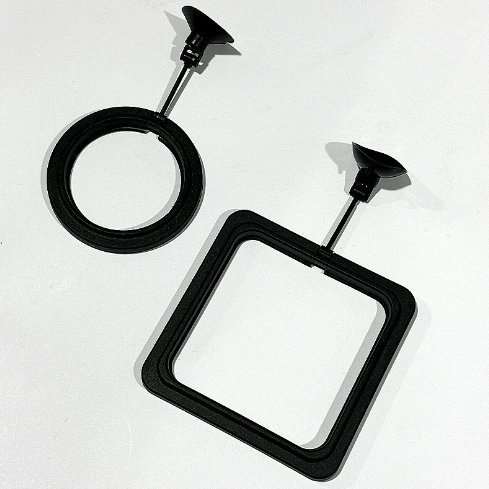
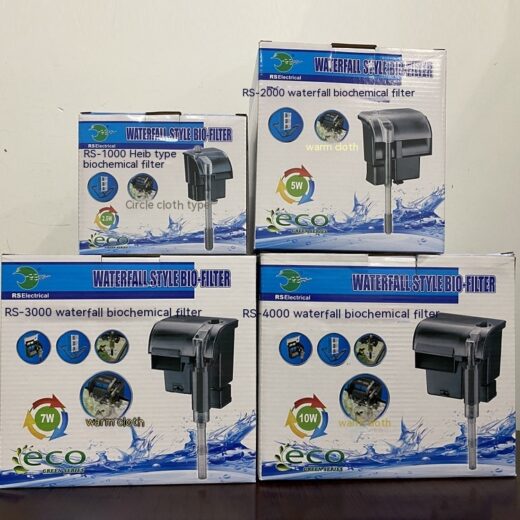
Aquarium Waterfall Bio Filter – RS1000 to RS4000
Products matched to this guide
Selected for relevance to the setup and needs covered above.
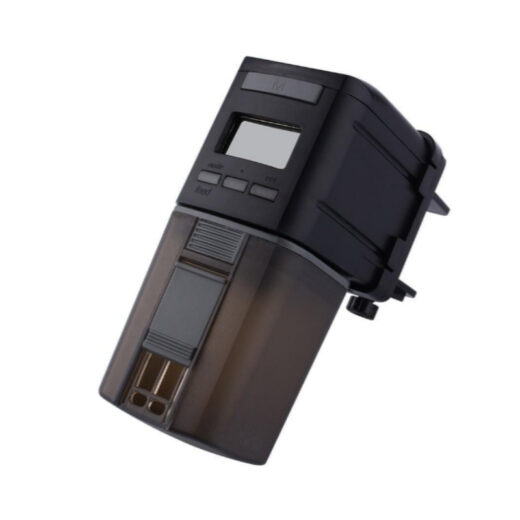
Automatic Fish Feeder for Goldfish & Koi – Standard/Wi-Fi
Automatic dry-food feeder for goldfish and koi, available as a standard black model or Wi-Fi remote-control…
View product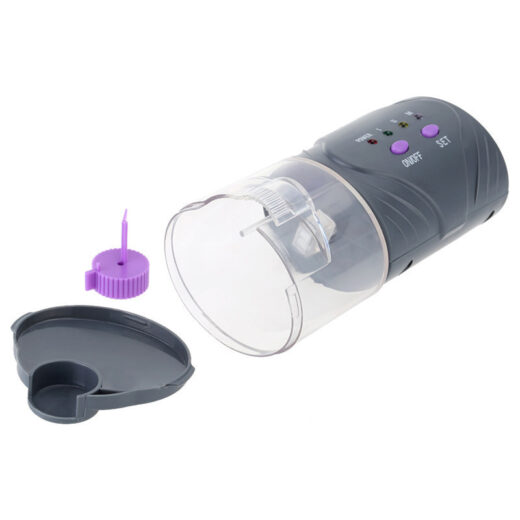
12/24-Hour Automatic Aquarium Fish Feeder
12/24-Hour Automatic Aquarium Fish Feeder — Schedule suitable dry food every 12 or 24 hours and…
View product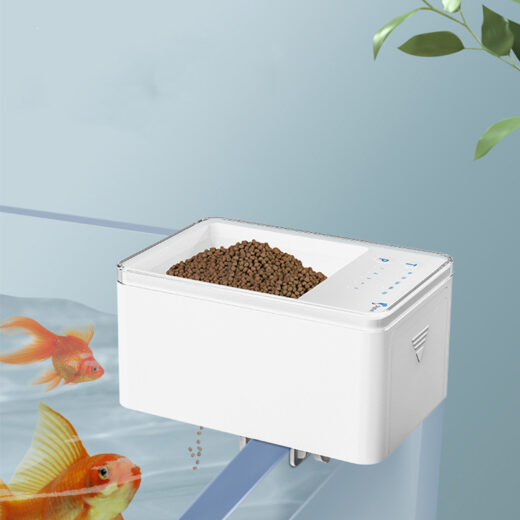
Digital Automatic Fish Feeder with LED Display – 500 ml
A compact 500 ml automatic aquarium feeder with an LED display, 24-hour scheduling and one-to-four daily…
View product