
Can Aquarium Plants Touch the Heater? Safe Placement Explained

Keep aquarium plants from resting against or wrapping around the heater. A leaf brushing past does not, by itself, tell you whether damage occurred, but persistent contact and crowded water flow are good reasons to adjust the layout. Start by observing from outside the tank. Before reaching in or moving anything, follow the electrical-disconnection and cooling instructions for your heater.
The useful question is whether leaves can move freely without crowding the equipment as they grow. A tidy gap on planting day may disappear once long leaves, stems or moss fill out.
What kind of contact are you seeing?
A passing leaf and a thick mat wrapped around a heater call for different responses. Neither the heater’s temperature setting nor a normal tank thermometer reading proves that contact with its surface is harmless. Avoid deliberately attaching plants to the heater, its cable or mounting bracket.
| What you see | What to check | Next action |
|---|---|---|
| A leaf occasionally sweeps close | Its full movement and where new growth will go | Keep open space around the heater and watch for repeated contact. |
| Leaves or moss lie against the body | The model’s shutdown, cooling and mounting instructions | After making maintenance safe, reposition or trim the plant appropriately. |
| Unexpected temperature or visible equipment damage | An independent thermometer and the manufacturer’s troubleshooting advice | Stop using damaged equipment; contact the manufacturer. Do not attempt electrical repairs. |
Let the heater manual set the placement
Find the exact model, then check its permitted mounting position, water-level requirements, supplied brackets and startup procedure. There is no plant-to-heater distance established by the manuals reviewed here that can be applied to every aquarium. A suggested gap from another aquarist is not a substitute for your model’s instructions.
For example, the Fluval T-Series instruction manual requires unobstructed circulation around the glass tube and recommends a position near moving water. It also warns against rocks, decorations or gravel touching the heater. Those instructions support keeping the surrounding area open; they do not establish a universal leaf-burn threshold.
Consider where mature plants will sit when you plan your planted-tank equipment. Leave room to inspect the heater and reach its mounting points during maintenance.
Make maintenance safe before clearing leaves
Disconnect all aquarium electrical equipment before putting your hands in the water. Allow the heater to cool as its manufacturer directs before handling or removal; never test its temperature by touching it. For the Fluval T-Series specifically, the manual requires at least 30 minutes of cooling after unplugging before taking it out of the water. Other models may have different instructions.
If a plug or outlet is wet, do not touch or unplug it. The Fluval instructions require power to be disconnected at the supplying fuse or circuit breaker first. If you cannot safely isolate the power, keep away and get qualified help. Do not reach into the tank or try to repair electrical equipment.
Before restarting, check the mounting, required immersion and any waiting period in the manual. Measure aquarium temperature with a separate, reliable thermometer rather than relying only on the heater’s dial.
Give growing plants somewhere else to go
Once the equipment is safely disconnected and cooled, move loose growth away from it. If contact keeps returning, consider relocating the plant or changing the heater position within the manufacturer’s permitted setup. Prune according to the plant’s growth form instead of repeatedly cutting whatever reaches the glass.
Check from the side as well as the front: a clear-looking view can hide leaves pressed behind the heater. Avoid replacing a plant obstruction with a rock or ornament. Make this inspection part of how you keep equipment accessible during plant maintenance.
Circulation matters to the plants, too. Aqueon’s Aquatic Plant Basics explains that water movement helps deliver nutrients and limits debris collecting on leaves. Keep the route around the heater open without using a stronger current to pin foliage elsewhere.
Is the heater responsible for damaged leaves?
A brown or translucent patch alone cannot identify the cause. Record whether the affected area actually rested on the heater, photograph it, and compare nearby leaves with leaves elsewhere in the tank. Check temperature and watch new growth after correcting the contact.
If deterioration also appears away from the heater, check other causes of unhealthy plant growth, including planting problems and adjustment after introduction. Avoid changing light, fertilizer and temperature together just because one leaf looks damaged.
Can plants hide a heater or touch a guard?
Plants can soften the view of equipment if circulation, inspection and maintenance access remain open. Plan for their mature size. A guard does not automatically make plant contact acceptable: use only accessories approved for the model, follow their instructions, and keep their openings free of growth. When the manual leaves a placement question unanswered, ask the manufacturer before experimenting.
Image: AI-generated conceptual illustration, not a tested installation. Mounting direction, immersion and clearances must follow your exact heater’s instructions.
Build a planted aquascape starter kit
Begin with a simple layout foundation, then choose lighting and maintenance tools that match the plants and available space.
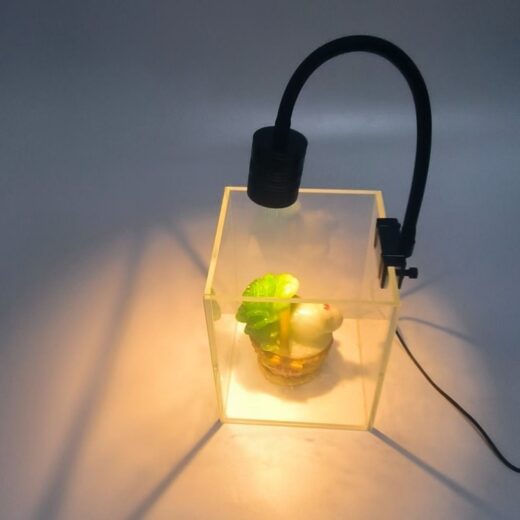
7 W USB Aquarium Plant Spotlight – Standard & Dimmable Models
This is a curated shopping path, not a one-size-fits-all bundle. Confirm dimensions, compatibility, livestock needs and electrical requirements before ordering.