
Planted Tank 101
A planted aquarium works when plants, light, carbon, substrate, nutrients, filtration and maintenance are planned as one system. This beginner roadmap shows what to decide, in what order, and which detailed guide to read next.
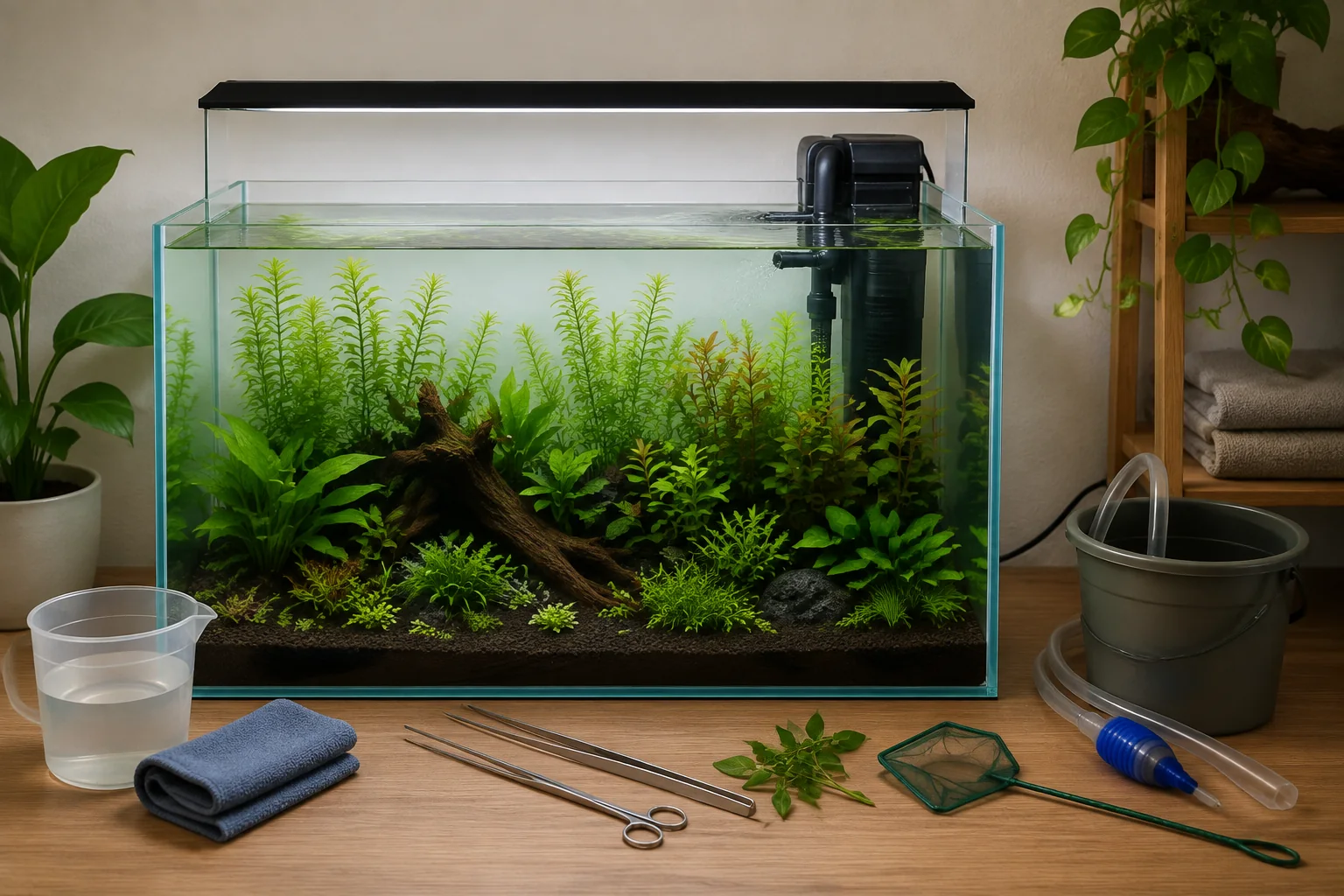
Plan the system before choosing products
The most common beginner mistake is to optimise one component in isolation. A powerful light can make an unsuitable plant list grow faster for a short time, but it also raises carbon and nutrient demand. Active substrate can help rooted plants, yet it may require a more careful start-up routine. A larger filter cannot compensate for unsuitable livestock, excessive feeding or neglected maintenance.
Use this page as the central decision path. Each cluster links to focused articles and then to the closest current DaraSphere product category. Where the catalogue does not yet contain a complete specialist CO₂, fertiliser, aquasoil or live-plant range, the guide says so rather than presenting an unrelated item as a complete solution.
| Decision | Choose it from | Do not choose it from |
|---|---|---|
| Plants | Temperature, light, tank size and upkeep | Colour or social-media appearance alone |
| Lighting | Coverage, control and plant demand | Maximum wattage alone |
| CO₂ | Growth goal and ability to regulate safely | The assumption that every tank needs it |
| Substrate | Plants, livestock and water chemistry | Texture or colour alone |
| Fertilisation | Plant feeding route and diagnosed need | A single symptom photograph |
Equipment and beginner mistakes
Choose the tank and life-support system before decorative upgrades. Every component must fit the real dimensions, operating volume, livestock needs, electrical destination and maintenance access.
What to verify
- Measure the tank, shelf, rim and equipment clearance.
- Select filtration and light as parts of the same planted system.
- Use conditional equipment only when a measured need exists.
Plant selection
Choose plants for the real temperature, light, tank height and maintenance time—not for appearance alone. Start with slow, adaptable species when you want a lower-energy aquarium, and check every plant against the needs of the livestock sharing the tank.
What to verify
- Match each species to verified temperature and light ranges.
- Plan foreground, midground and background space before ordering.
- Prefer a smaller list of compatible plants over a crowded impulse selection.
Lighting
Light sets the pace of the whole planted system. The correct fixture must fit the tank, cover its planted footprint and offer repeatable control. More output is not automatically better: strong light increases demand for carbon, nutrients, circulation and maintenance.
What to verify
- Confirm tank length, mounting method, voltage and plug type.
- Begin with a conservative, repeatable photoperiod.
- Change intensity or duration one variable at a time.
CO₂
Pressurised CO₂ is an optional management choice, not a requirement for every planted tank. Easy plants under moderate light can succeed without it. Dense carpets, faster growth and demanding red plants may justify controlled injection only when the owner can operate it consistently and safely.
What to verify
- Decide from plant demand and growth goals.
- Stabilise light and circulation before increasing carbon demand.
- Never use a colour indicator as a substitute for livestock observation.
Substrate
Substrate affects planting, nutrient access, water chemistry and long-term maintenance. Active aquasoil, inert sand and gravel solve different problems. Select the material only after deciding which plants, animals and water parameters the aquarium must support.
What to verify
- Check whether the material changes pH, hardness or ammonia.
- Plan enough depth for roots without creating inaccessible debris traps.
- Treat hardscape weight, stability and displacement as part of the calculation.
Fertilization
Fertilisation should answer a diagnosed need. Liquid nutrients feed the water column; root tabs target rooted plants in inert substrate. Plant symptoms can overlap with light, carbon, circulation and acclimation problems, so avoid dosing from a photograph alone.
What to verify
- Identify whether plants feed mainly through leaves, roots or both.
- Record dose, frequency and plant response.
- Change one variable at a time and respect the product label.
Cycling
A planted layout is not automatically biologically mature. Active substrate can release compounds during start-up, filters need time to establish, and animal stocking must follow verified water conditions rather than a fixed calendar date.
What to verify
- Use a filter and media appropriate for the real water volume.
- Follow the substrate manufacturer’s start-up instructions.
- Add livestock only after the cycle and species requirements are verified.
Algae control
Algae is usually a system signal, not a reason to reach for a single miracle product. Identify the algae first, then review light, organic waste, plant health, circulation and maintenance consistency. Manual removal is useful, but prevention depends on correcting the underlying imbalance.
What to verify
- Identify the growth before choosing a response.
- Remove affected material and excess waste carefully.
- Correct the repeatable cause instead of repeatedly treating the symptom.
Maintenance
A sustainable planted aquarium has a routine the owner can repeat. Water changes, glass cleaning, plant trimming, filter care and equipment inspection should be scheduled around the tank’s actual behaviour—not performed randomly after visible problems appear.
What to verify
- Create a weekly observation and water-care routine.
- Keep separate tools for trimming, planting and glass work.
- Inspect flow, temperature, seals, cables and plugs regularly.
Beginner build order
- Choose the livestock, real water volume and safe tank position.
- Set the maintenance level: low-tech, higher-growth or a carefully controlled hybrid.
- Select compatible plants and reserve enough planting space.
- Choose substrate and hardscape with water chemistry and stability in mind.
- Match the light to the tank footprint and chosen plants.
- Add filtration, heating or cooling, monitoring and electrical safeguards.
- Plant, fill and cycle using the relevant manufacturer instructions.
- Stock only after verified stability, then adjust one variable at a time.
Planted Tank 101 FAQ
Does a beginner planted tank need CO₂?
No. A lower-energy layout can be built with suitable easy plants and moderate light. Added CO₂ becomes relevant when the plant list and growth target justify the extra control and maintenance.
Which should be chosen first: plants or lighting?
Define the livestock, tank dimensions and maintenance target first, then choose a compatible plant list. The light should be selected to support that list across the actual planted footprint.
Can fish or shrimp be added immediately after planting?
Planting does not prove biological maturity. Add animals only after cycling is verified and the temperature, water chemistry and habitat match the selected species.
Is algae normal in a new planted aquarium?
Some early algae or diatom pressure is common, but it should still be diagnosed. Review light, waste, circulation, plant health and start-up care instead of assuming every growth is harmless.
Should fertilizer be added from day one?
Follow the substrate, plant and fertilizer manufacturer’s instructions. The correct start depends on whether the substrate is active or inert and how the plants obtain nutrients.
Editorial sources
This pillar is an original DaraSphere decision framework based on current catalogue checks and established manufacturer guidance. Specifications and availability can change; confirm the live product page before ordering.