
Cyanobacteria in Aquariums: Identify Slime and Act Safely

Cyanobacteria can look like algae, but the sheet-like growth needs its own diagnosis and a removal plan that protects livestock and avoids spreading fragments around the aquarium.
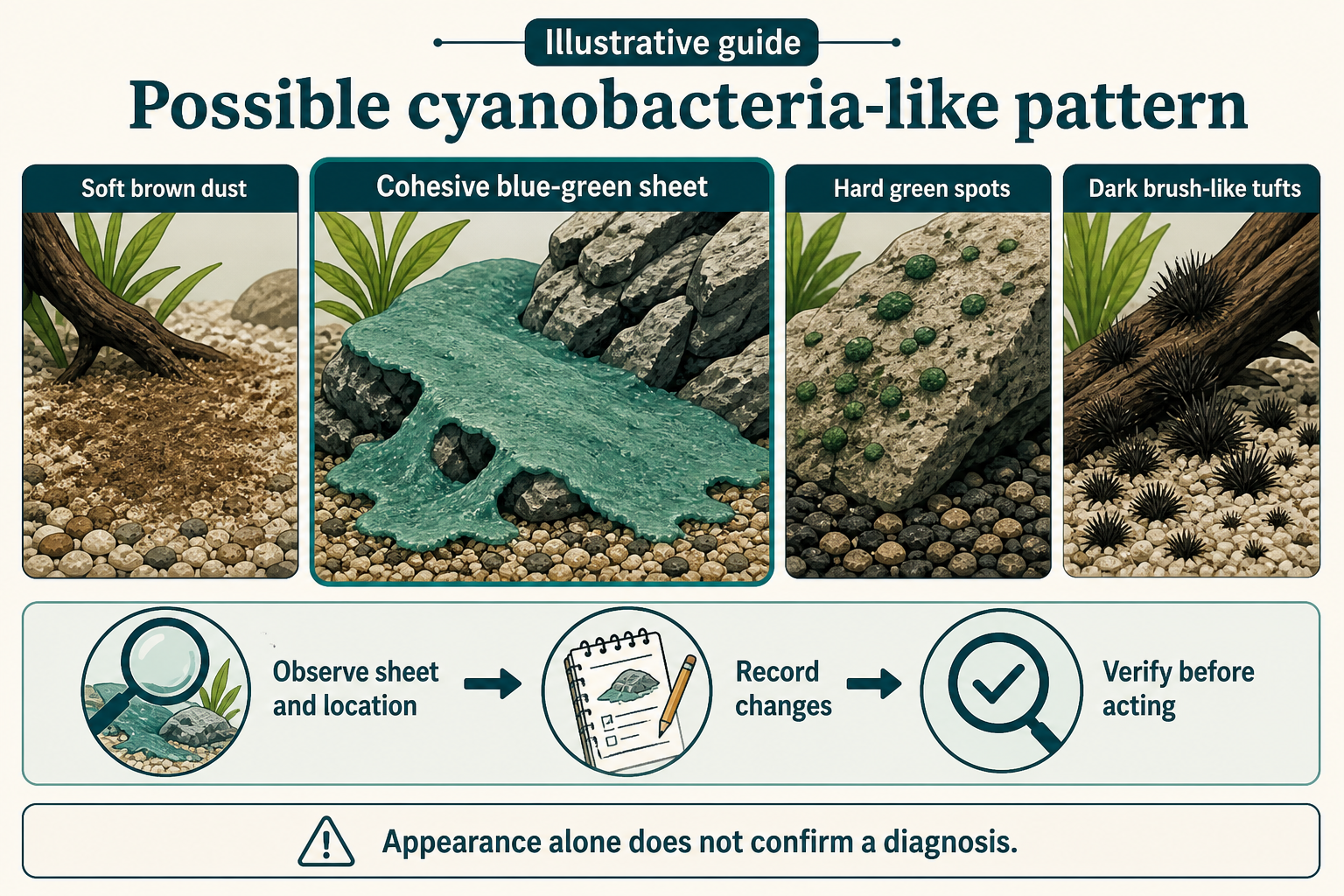
Does the growth behave like cyanobacteria?
Colour is not enough. Cyanobacterial mats may be blue-green, dark green, brownish, reddish or nearly black. The University of Florida IFAS marine-aquarium guide describes them as microscopic photosynthetic organisms that can form large coloured mats and notes siphoning during a water change as a removal method. In freshwater planted tanks, use the following field clues together:
- Cohesive sheet: it lifts, folds or peels more like a thin film than separate hairs.
- Fast surface coverage: it spreads across substrate, plant leaves or hardscape as a connected skin.
- Trapped bubbles: bubbles may collect beneath or within the mat under light, but this is not unique proof.
- Distinctive earthy or swamp-like smell: a supporting clue only; do not deliberately inhale material.
Filamentous algae pulls into strands, diatoms usually wipe away as a dusty brown coating, and mulm breaks apart as loose debris. Mixed growth is possible. If the identification remains uncertain, remove a small sample mechanically and obtain a clear close-up for a qualified aquarium professional before choosing a treatment.
Plan one controlled removal session
Before the water change
- Check livestock behaviour, temperature and filter flow.
- Prepare replacement water using the normal species-appropriate method.
- Position a siphon close to the mat before disturbing it.
- Use dedicated aquarium tools and protect cuts or irritated skin; wash hands after aquarium work.
During removal
- Lift an edge gently and siphon the loosened sheet at the same time.
- Remove badly smothered or decaying leaves rather than shredding the mat in place.
- Work in small sections. Do not stir the entire substrate to chase every fragment.
- Clean accessible intake guards and obvious debris pockets without dismantling all filtration.
After refill
- Restart required equipment and confirm normal circulation, temperature and leak-free fittings.
- Dispose of removed material; do not return tool rinse-water to the aquarium.
- Photograph the cleared zones so recurrence can be compared at the next observation.
Find the condition that lets the mat return
| Where it starts | Check first | Targeted correction |
|---|---|---|
| Behind rock or wood | Dead zones, trapped food and decaying leaves | Improve access and gentle local circulation; remove waste at the source. |
| Across exposed substrate | Settled organic material, plant coverage and recent disturbance | Use surface siphoning and restore healthy plant mass without deep, uncontrolled stirring. |
| Near a weak intake or outlet | Reduced flow, clogged prefilter or changed outlet direction | Service only the obstructed component according to its manual and verify the return pattern. |
| After overfeeding or livestock change | Uneaten food and increased waste load | Return feeding to species-appropriate portions and remove leftovers promptly. |
| After plant melt | Unremoved decaying material and reduced competition from healthy growth | Prune deteriorating leaves and recheck why the exact plant is failing. |
Do not turn this table into a universal nutrient prescription. Aquarium measurements are meaningful only with the correct test method, water context and livestock needs. Correct the observed mismatch rather than chasing a single internet target.
What about a blackout?
Darkness may reduce photosynthetic growth, but it does not remove trapped waste, restore a blocked flow path or identify why the mat appeared. A blackout is not a substitute for removal and diagnosis. If one is considered, protect livestock oxygenation, follow species-specific guidance and do not combine it with a chemical treatment whose ingredients, dose or compatibility have not been confirmed.
Track recurrence by place, not by impression
For the next few maintenance visits, record the first location where the mat returns, time since removal, light schedule, flow changes, feeding changes and plant deterioration. A smaller patch returning in the same low-flow pocket points to a different next step than new mats appearing throughout the aquarium.
- If it returns only in one pocket, improve access and local flow.
- If it follows repeated decay, correct the plant or husbandry problem creating that material.
- If it spreads rapidly despite careful removal and stable maintenance, seek qualified identification and treatment advice with the livestock list, tank volume, recent changes and clear photographs.
Short answers
Will an algae-eating animal remove cyanobacteria?
Do not buy livestock as a treatment assumption. Cyanobacteria is not ordinary algae, animal diets vary, and adding livestock also adds care and waste requirements.
Should all filter media be replaced?
No. Replacing every stage can remove established filtration without correcting the source. Service obstructed components in stages and follow the filter manufacturer’s media instructions.
Can I leave a small mat until the next water change?
Remove it promptly when it is smothering plants, spreading or associated with livestock distress. If immediate removal would be unsafe, prioritise animal welfare and obtain qualified help.
Sources
Build a reliable automatic-feeding setup
Start with a compatible feeder, then protect the routine with suitable water-care and maintenance equipment.
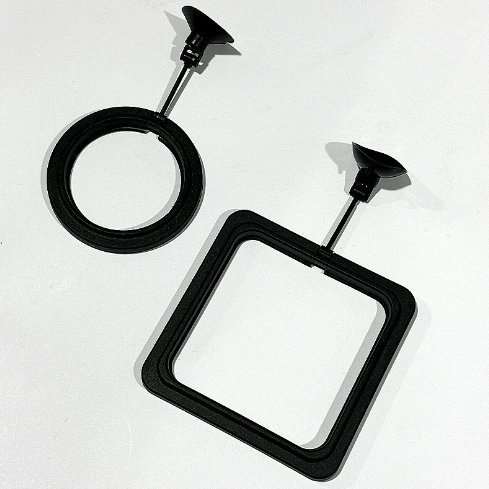
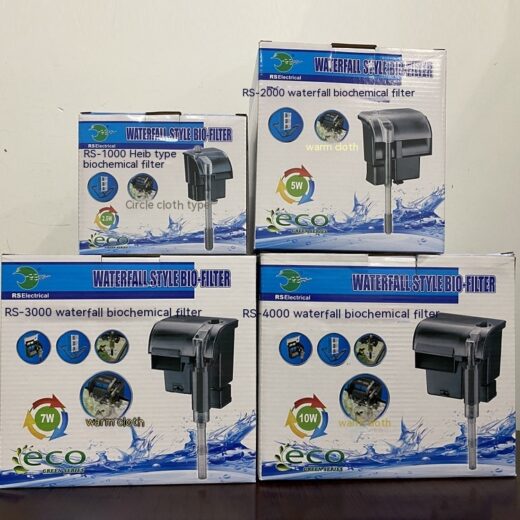
Aquarium Waterfall Bio Filter – RS1000 to RS4000
Products matched to this guide
Selected for relevance to the setup and needs covered above.
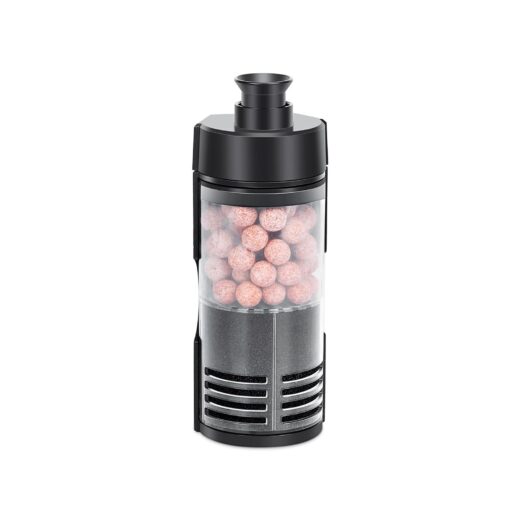
Bio Sponge Filter for Betta, Shrimp & Fry – 2–20 Gallons
Bring sponge and ceramic-media filtration together in a compact, air-driven filter. Choose Small for 2–5-gallon aquariums…
View product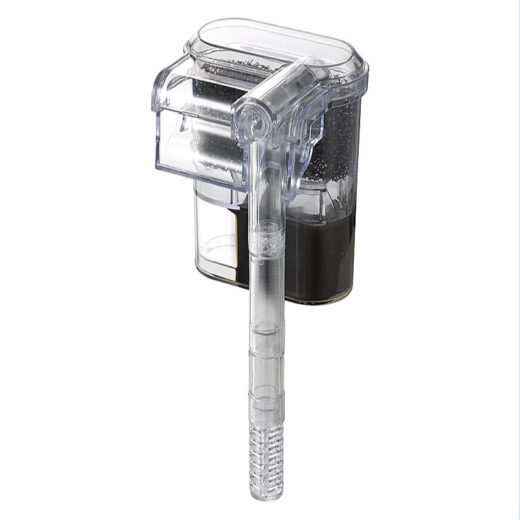
USB Mini Hang-On Waterfall Aquarium Filter
A compact USB-powered hang-on waterfall filter for small aquariums. Its transparent-grey ABS housing keeps the tank…
View product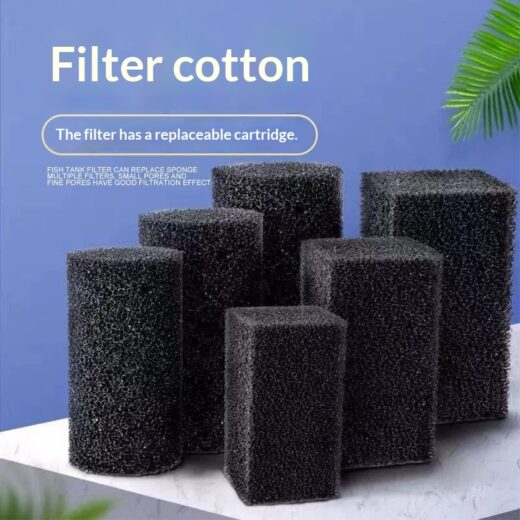
Replacement Aquarium Filter Sponge – 4 W, 6 W & 15 W Models
Refresh your filter media with replacement sponges in round or square shapes. Choose a 4 W,…
View product