
Aquascaping Golden Ratio: Useful Guide, Not a Fixed Rule
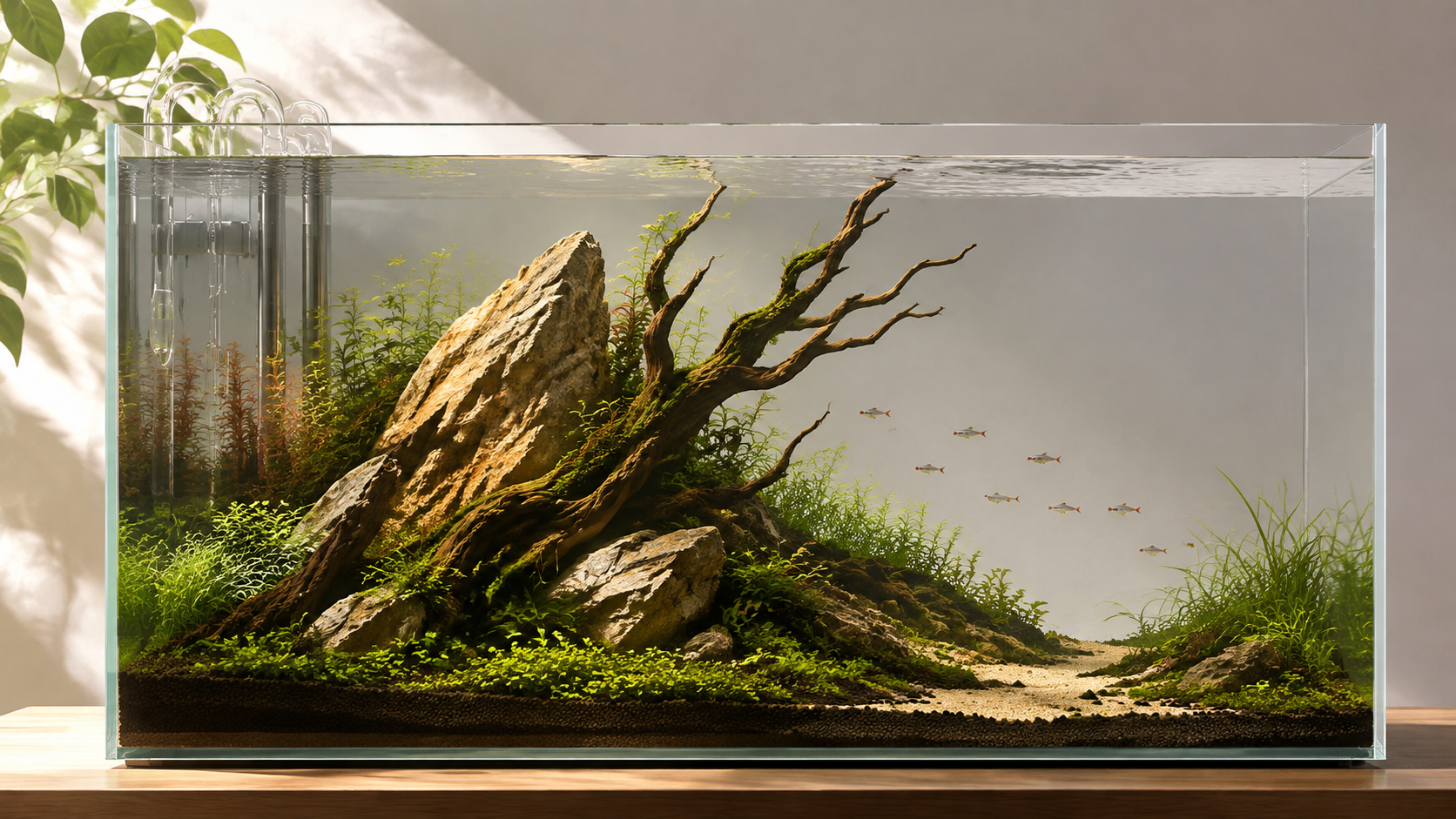
The golden ratio is a composition aid, not a rule that can make an aquascape successful. It can suggest where a dominant form might sit in the front view, but the final layout must also work in three dimensions, remain stable and leave space for plants, livestock and maintenance.
Use ratio or thirds overlays while comparing early layouts. Then judge the hardscape from the position where the aquarium is normally seen. A stone placed on a mathematically attractive point can still look weak if its angle, supporting forms and surrounding space do not reinforce it.
Use the overlay to ask better questions
Place an approximate ratio grid over a straight front-view photograph or sketch. Move the dominant stone, wood junction or main plant mass around the suggested zones and ask what changes: Does the eye reach that area naturally? Does the rest of the material support it? Is there enough quiet space for the focal form to remain clear?
The overlay is most useful before the aquarium is planted, when several arrangements can still be tested. It should prompt alternatives rather than select a winner automatically.
Judge the layout from its real viewing position
An aquascape has depth, while a grid is flat. View the tank from the front and from any angle that will be common in the room. A focal stone may align well in a photograph but disappear behind wood or plants when seen from a chair, doorway or side panel.
Tank proportions also affect how the composition reads. Work with the internal footprint, glass height and visible equipment instead of copying the location of a focal point from a different aquarium.
Establish one dominant form and a supporting direction
Choose the element that should carry the most visual weight. Smaller pieces can repeat its angle, texture or direction without competing for equal attention. When every stone points differently or every piece of wood becomes a separate focal point, a ratio line cannot restore hierarchy.
Repeated direction does not require identical material. The important check is whether the supporting forms lead towards, frame or balance the dominant mass. Remove pieces that only fill a calculated gap and do not contribute to that relationship.
Keep negative space as part of the design
Empty sand, open water and gaps between hardscape groups can make the focal area more legible. Protect those spaces during the dry layout rather than hoping they remain after planting. Consider how leaves will spread, how stems will be trimmed and where livestock will move once the aquarium matures.
| What you see in the test photograph | What to check next |
|---|---|
| The focal piece looks isolated | Change the direction or scale of supporting forms before adding more material. |
| The layout feels crowded | Remove a piece and reassess the open areas from the normal viewing position. |
| The eye stops at several equal points | Reduce competition by choosing one dominant mass and quieter secondary groups. |
| The composition works only in a flat image | Inspect depth, overlap and silhouettes from the room’s other common angles. |
Let stability and access overrule geometry
Do not balance a heavy stone precariously or bury its support simply to hit a coordinate. Test the hardscape’s physical stability before filling the tank, using methods appropriate to the exact materials and aquarium. Keep it clear of the glass where contact or movement could cause damage.
Reserve practical routes to the filter intake and outlet, the substrate surface and any area that will need trimming. A composition that cannot be cleaned or serviced without dismantling its focal group is not improved by mathematical placement.
Plan for the shape plants will create later
The focal area will change as plants gain height and mass. Decide whether planting should expose, frame or eventually soften the dominant hardscape. Use the mature form of the selected species in that decision; a foreground plant, spreading epiphyte or dense stem group will not occupy space in the same way.
Photograph the dry layout and compare it with later growth from the same viewing position. If the intended hierarchy disappears, first consider trimming or reducing the plant mass around it. Moving the hardscape in an established aquarium is a much larger intervention.
Apply the method without assuming identical local conditions
The composition method is independent of country, but the aquarium is not. Buyers in the UAE and GCC, the UK, Germany and the Netherlands should verify the identity and aquarium suitability of locally available stone or wood, as well as the tank’s measured source water and room conditions. Never infer a material’s effect on water chemistry from appearance alone.
If a commercial listing does not identify the material or provide enough preparation guidance, leave it out of the plan until that information is available. A substitute with a similar colour may behave differently and need a different safety check.
A dry-layout exercise before planting
- Mark the internal footprint and the areas needed for equipment and maintenance.
- Choose one dominant stone, wood group or future plant mass.
- Photograph several positions near thirds or approximate ratio zones.
- Add only supporting forms that reinforce the main direction or balance.
- Remove material until the negative space is visible and usable.
- Inspect the arrangement from every normal viewing angle.
- Test physical stability and access before substrate, plants or livestock are added.
Tropica’s planted-aquarium start guide provides relevant context for the stage after layout, while ADA’s documented creation process offers a visual example of developing a composition. Neither source turns a ratio overlay into a fixed placement rule.
Related DaraSphere guides: Aquarium Substrate and Hardscape, Substrate Depth and Slope and Preparing Aquarium Driftwood.
Build a planted aquascape starter kit
Begin with a simple layout foundation, then choose lighting and maintenance tools that match the plants and available space.
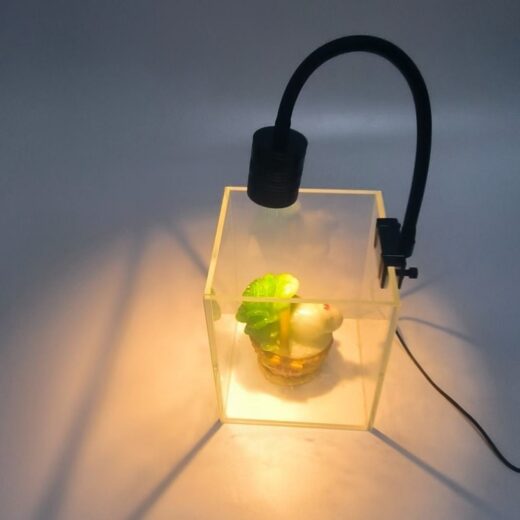
7 W USB Aquarium Plant Spotlight – Standard & Dimmable Models
Products matched to this guide
Selected for relevance to the setup and needs covered above.
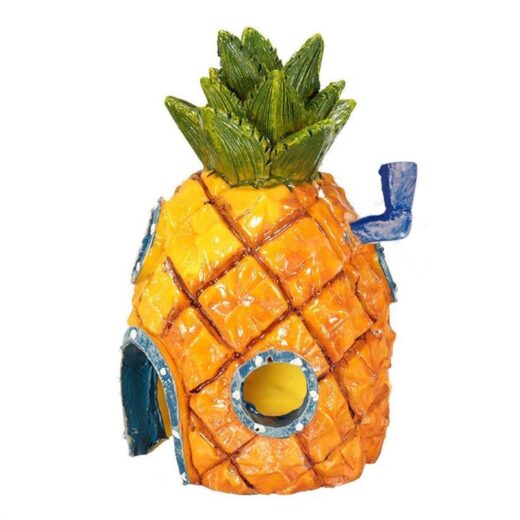
Pineapple House Aquarium Decoration – Resin 13 cm
A playful pineapple-house ornament made from resin. The compact design measures approximately 7.5 × 7.5 ×…
View product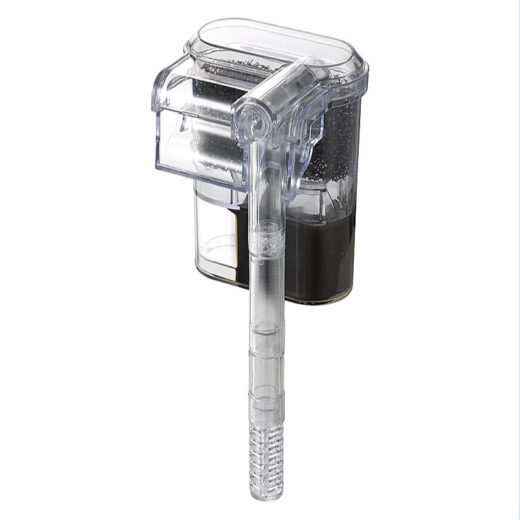
USB Mini Hang-On Waterfall Aquarium Filter
A compact USB-powered hang-on waterfall filter for small aquariums. Its transparent-grey ABS housing keeps the tank…
View product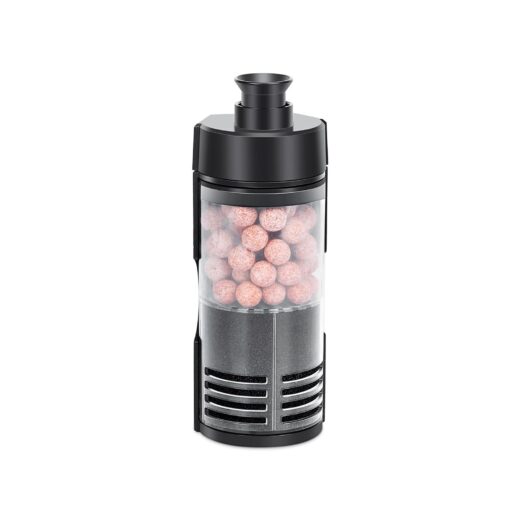
Bio Sponge Filter for Betta, Shrimp & Fry – 2–20 Gallons
Bring sponge and ceramic-media filtration together in a compact, air-driven filter. Choose Small for 2–5-gallon aquariums…
View product