
Aquascaping Styles
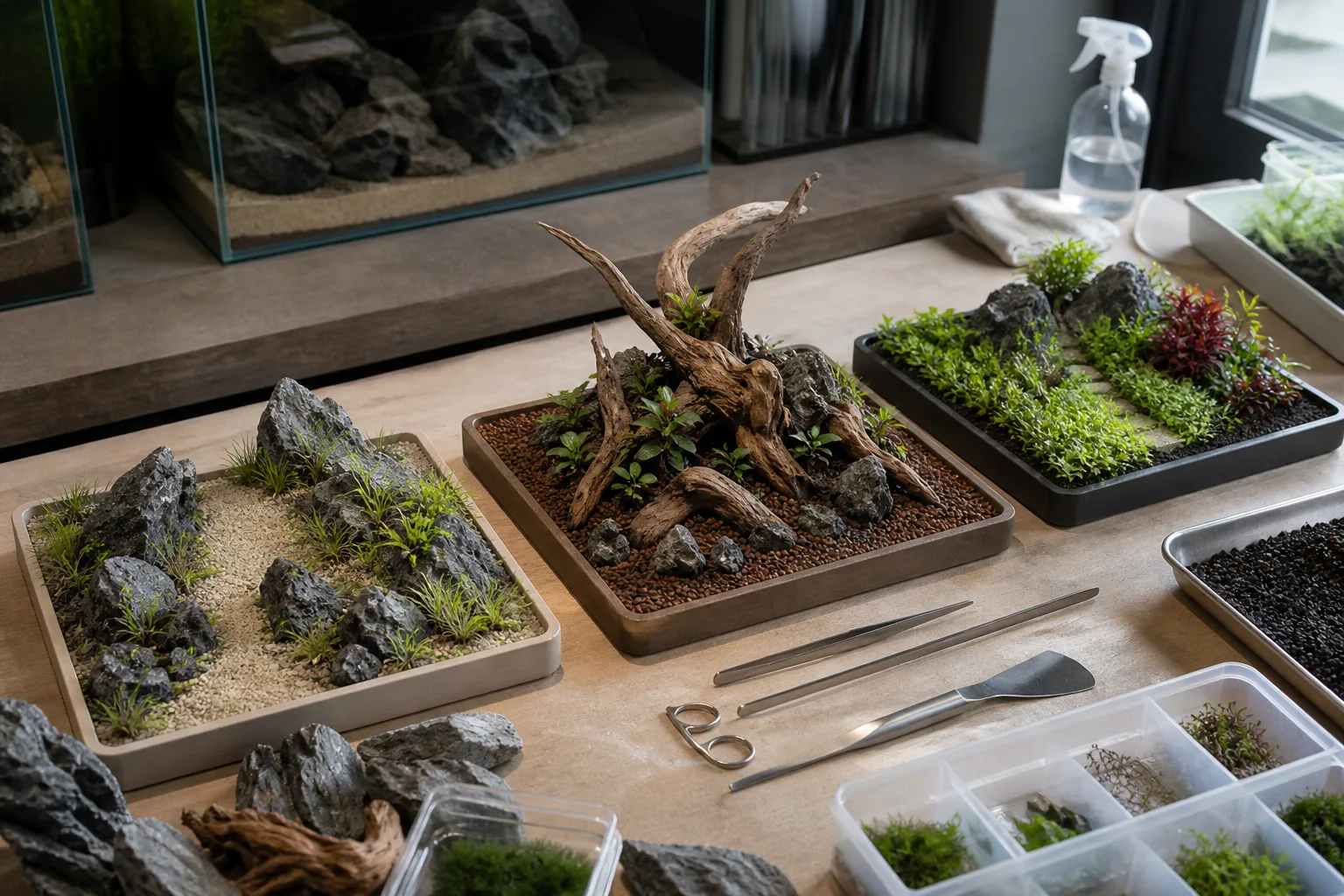
A style is useful only when it changes the plan. Translate the visual idea into composition, plant roles, hardscape access and a maintenance routine before selecting materials.
Use four design questions
- Where is the visual weight?
- Which areas remain open?
- How do plants change the composition as they mature?
- Can every important area still be reached for maintenance?
Keep named methods in scope
ADA describes Nature Aquarium as a planted-aquarium approach with its own concept and maintenance methods. Source: Aqua Design Amano: What is Nature Aquarium?.
ADA presents Nature Aquarium creation as a staged process rather than a single finished-image choice. Source: Aqua Design Amano: Nature Aquarium Starting from Zero.
Use style names as planning routes, not definitions
Each row is an explicit question to take into the linked guide. It does not define the style or claim that every layout using that label shares the same features.
| Route under consideration | Planning prompt | Focused guide |
|---|---|---|
| Iwagumi | Which stone roles and open areas will you record before deciding whether this route fits? | Open the Iwagumi planning list |
| Nature Aquarium | Which stages and maintenance records from the official ADA process are relevant to this plan? | Open the Nature Aquarium planning list |
| Dutch | Which plant-group decisions and recurring maintenance tasks can this plan support? | Open the Dutch aquascape guide |
| Jungle | Where must access and circulation remain open as the planned plant mass changes? | Open the Jungle aquascape guide |
| Nano | How will the plan record scale, displacement and equipment access before materials are chosen? | Open the Nano design guide |
| Wabi-Kusa | Which emersed-display conditions and maintenance tasks still require evidence for this proposed route? | Open the Wabi-Kusa guide |
Compare constraints before choosing a label
List the aquarium’s non-negotiable constraints first: available footprint, equipment access, maintenance frequency, material evidence and plant-care capacity. Then compare style routes against those constraints. This prevents a style name from hiding the work required to keep its composition legible.
Two layouts can borrow the same visual device without becoming the same style. A strong stone line, dense planting or open sand is a component; the planning contract is the combination of composition, materials, plant roles and maintenance. Use the child guide when a named route needs deeper instructions.
Work through a style decision example
- Write the visual goal: for example, an open foreground with one dominant material line.
- Write the operational limit: which areas must remain reachable and what maintenance can repeat.
- Compare two routes: note what each route changes in plant choice, hardscape and open space.
- Make a dry plan: mark the mature plant mass and the equipment path.
- Keep the label provisional: confirm the route only when the plan, not merely the inspiration image, matches.
Where this hub ends
This page owns comparison between proposed routes. The linked guides own their detailed planning questions. Return here only when the completed records expose a cross-route trade-off; do not use this hub as a factual definition of Iwagumi, Dutch, Jungle, Nano or Wabi-Kusa.
Failure modes in style selection
- Copying a finished image without recording the grow-in and maintenance path.
- Using a style label to justify materials whose identity or suitability is unknown.
- Planning the front view while blocking equipment or trimming access.
- Combining several style rules without deciding which one owns the composition.
- Letting the hub duplicate the detailed instructions of every child guide.
Dry-plan before commitment
- Draw the front-view composition.
- Mark mature plant mass, not just new planting.
- Mark intake, outlet and maintenance access.
- Record which style rules are essential and which are optional.
- Photograph the dry fit for comparison.